Neon Tetra: Complete Care Guide, Tank Setup, Water & Tank Mates
The neon tetra (Paracheirodon innesi) is one of the most popular freshwater aquarium fish. Its bright blue and red stripe and peaceful, schooling nature make it a classic choice for community tanks. This guide covers everything aquarists search for: neon tetra tank size, water parameters, feeding, tank mates, Neon Tetra disease, and how to keep them healthy and colourful.
Neon Tetra Quick Facts
Key facts that fishkeepers look for when researching neon tetras.
- Scientific name: Paracheirodon innesi
- Origin: South America (Amazon basin: Brazil, Colombia, Peru)
- Size: Up to about 3.8 cm (1.5 in) total length
- Lifespan: 5–7 years in optimal conditions
- Tank size: Minimum 38 L (10 gal) for 6–8; 75 L (20 gal) or more ideal for a school of 10–15
- Water: Soft, slightly acidic; pH 6.0–7.0, 22–26 °C (72–78 °F)
- Temperament: Peaceful; must be kept in a school (6+)
- Diet: Omnivore; small foods (micro pellets, fine flakes, live/frozen)
Neon Tetra History and Origin
The neon tetra was first described in 1936 and quickly became a staple of the aquarium trade. It is native to blackwater and clearwater streams and tributaries of the Amazon basin in Brazil, Colombia, and Peru, where it lives in large shoals in shaded, soft, acidic water. Wild-caught specimens are still traded, but most sold today are farm-raised. Its striking colours and small size made it one of the first “nano” and community-tank favourites worldwide.
Neon Tetra Appearance
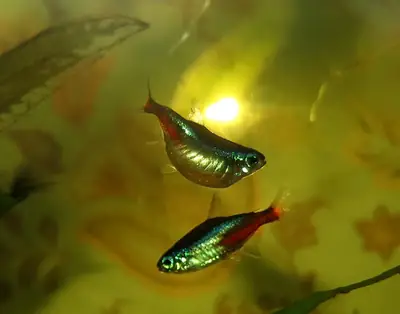
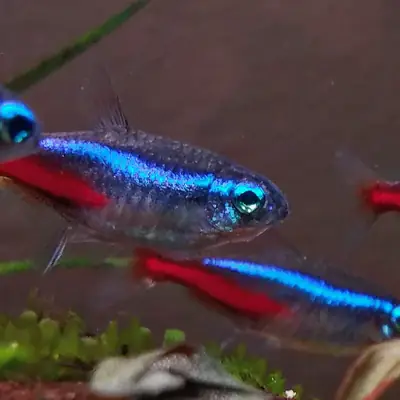
Neon tetras have a slender, slightly compressed body with a bright iridescent blue horizontal stripe from the nose to the adipose fin and a red stripe from the middle of the body to the tail. The belly is silver-white. Under good lighting and in a well-maintained tank, the blue can appear almost electric. Males tend to be slimmer with a straighter blue line; females are rounder, especially when carrying eggs, and the blue line may appear slightly curved. Colour intensity depends on diet, water quality, and stress levels.
Neon Tetra Behaviour and Schooling
Neon tetras are schooling fish. They should never be kept alone or in very small numbers. A group of at least 6–8 is the minimum; 10–15 or more is better and allows natural shoaling behaviour—they swim in a coordinated group, which reduces stress and brings out their best colour. Kept in too small a group or in a bare tank, they can become shy, pale, or prone to hiding. With the right group size and planted tank, they are active, confident, and strikingly colourful.
Neon Tetra Tank Setup and Size
A minimum of about 38 L (10 US gallons) is often cited for a small group of 6–8 neon tetras, but a larger tank is better for water stability and for a proper school. 75 L (20 gal) or more gives room for 10–15 fish and makes maintenance easier. Choose a tank that is longer rather than tall—neon tetras use horizontal swimming space. Use a lid to prevent jumping. Provide soft substrate, plenty of plants (real or silk), and some hiding spots. Gentle filtration (e.g. sponge filter or HOB with low flow) avoids strong currents that stress these small fish.
Filtration and Heater
Use a filter that does not create a strong current; neon tetras come from slow-moving waters. A heater is essential to keep the temperature stable at 22–26 °C (72–78 °F). Sudden temperature or water-quality changes can stress or kill them.
Neon Tetra Water Parameters
Neon tetras are sensitive to water quality and chemistry. Aim for stable, soft, slightly acidic conditions:
- pH: 6.0–7.0 (slightly acidic)
- Temperature: 22–26 °C (72–78 °F)
- General hardness (GH): 3–8 dGH (soft water)
- Carbonate hardness (KH): 1–2 dKH
- Ammonia: 0 ppm
- Nitrite: 0 ppm
- Nitrate: Keep low, ideally under 20 ppm
Perform regular partial water changes (e.g. 25–30% weekly) and avoid large, sudden changes. If your tap water is hard or alkaline, consider using RO water or a soft-water mix.
Neon Tetra Diet and Feeding
Neon tetras are omnivores with small mouths. Feed a variety of small-sized foods for health and colour:
- High-quality micro pellets or fine tropical flakes as a staple
- Freeze-dried or frozen bloodworms, tubifex, daphnia (occasional treats)
- Live foods when possible: brine shrimp, micro worms, daphnia
Feed small amounts once or twice a day; only what they can finish in a couple of minutes. Overfeeding leads to poor water quality and health problems. A varied diet supports strong colours and immune function.
Neon Tetra Tank Mates
Neon tetras are peaceful and suited to community tanks with other small, non-aggressive fish. Good tank mates include:
- Other tetras: cardinal tetra, rummy-nose tetra, glowlight tetra, black neon tetra
- Small rasboras, danios, and peaceful barbs
- Dwarf cichlids (e.g. apistogramma) in appropriate setups
- Small catfish (e.g. Corydoras, otocinclus) and peaceful shrimp
Avoid large, aggressive, or predatory fish that may eat or harass them. Keep them with species that share similar water parameters (soft, slightly acidic, warm).
Neon Tetra Health and Disease
With good water quality, a proper school, and a balanced diet, neon tetras can live 5–7 years. They are sensitive to ammonia, nitrite, and sudden changes.
Neon Tetra Disease (NTD)
Neon Tetra Disease is caused by the parasite Pleistophora hyphessobryconis. It is usually fatal and has no known cure. Symptoms can include loss of colour, restlessness, difficulty swimming, curved spine, and cysts. Infected fish should be removed to limit spread (although the parasite can persist in the tank). Buying from reputable sources and quarantining new fish can reduce the risk. There is also a “false neon tetra disease” caused by bacteria, with similar signs; a vet or lab can help distinguish. Good hygiene, stable water, and low stress help keep fish resilient.
Other Health Tips
Prevent ich (white spot), fin rot, and stress by maintaining stable parameters, avoiding overcrowding, and quarantining new arrivals. Watch for lethargy, loss of appetite, or clamped fins and address water quality first.
Breeding Neon Tetras
Breeding neon tetras in the home aquarium is possible but can be tricky. They are egg scatterers and may eat their eggs. Use a separate, dimly lit breeding tank with very soft, acidic water (e.g. pH around 6.0, low GH). Some breeders use peat or almond leaves to darken and soften the water. Condition the pair with live or frozen foods. Spawning often occurs in the morning. Remove the adults after spawning to protect the eggs. Fry are tiny and need infusoria or other fine foods at first, then baby brine shrimp. Males are slimmer with a straight blue stripe; females are rounder with a bent blue stripe.
Frequently Asked Questions About Neon Tetras
How many neon tetras should I keep?
At least 6–8; 10–15 or more is better. They are schooling fish and need a group to feel secure and show natural behaviour and colour.
What size tank do neon tetras need?
Minimum about 38 L (10 gal) for a small group; 75 L (20 gal) or more is better for a proper school and stable water.
What water temperature do neon tetras need?
22–26 °C (72–78 °F). Use a reliable heater and avoid sudden temperature changes.
How long do neon tetras live?
In optimal conditions, 5–7 years. Water quality, tank size, diet, and stress all affect lifespan.
Can neon tetras live with bettas?
Sometimes, in a large enough tank with plenty of cover and a calm betta. Bettas can nip fins or attack small fish; monitor carefully and have a backup plan.
Why are my neon tetras losing colour?
Stress, poor water quality, too small a group, or illness (including Neon Tetra Disease). Check parameters, increase group size if needed, and ensure a varied diet and stable conditions.
What do neon tetras eat?
Small micro pellets, fine flakes, and occasional freeze-dried or frozen foods (bloodworms, brine shrimp, daphnia). Variety supports colour and health.
Is the Neon Tetra Right for You?
Neon tetras suit beginners and experienced aquarists who can provide soft, acidic, stable water and a planted tank with a school of at least 6–8 fish. They are not suitable for hard, alkaline tap water without adjustment or for tanks with aggressive or large fish. If you are ready for regular maintenance and stable parameters, neon tetras are one of the most rewarding and iconic community fish.