Freshwater Aquarium Sharks: Complete Guide to Care, Feeding and Aquarium Setup
Freshwater aquarium sharks, unlike true sharks, are cyprinid fish from the Cyprinidae family. Popular species such as Bala Shark, Rainbow Shark, Red-tailed Black Shark, and Iridescent Shark hold a special place in the aquarium hobby. This comprehensive guide provides detailed information on care, feeding, aquarium setup, and health management for freshwater aquarium shark species.
1. Species Profile and General Characteristics
- Origin: Southeast Asia (Sumatra, Borneo, Thailand, Malaysia); freshwater fish from Cyprinidae family. Not true sharks, named for their shark-like appearance.
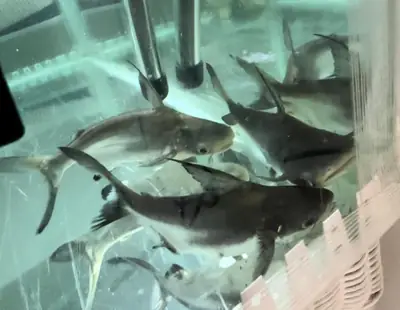
- Popular Species: Bala Shark (Balantiocheilos melanopterus), Rainbow Shark (Epalzeorhynchos frenatum), Red-tailed Black Shark (Epalzeorhynchos bicolor), Iridescent Shark (Pangasius hypophthalmus).
- Size: Varies by species: Rainbow and Red-tail 5-6 inches; Bala Shark 10-14 inches; Iridescent Shark 40+ inches (requires very large aquarium).
- Lifespan: 5-10 years (under proper care conditions), some species can live up to 15 years.
- Character: Varies by species: Bala Shark peaceful schooling fish; Rainbow and Red-tail territorial and semi-aggressive; Iridescent active and large.
2. Aquarium Setup and Water Parameters
2.1 Aquarium Size and Requirements
| Species | Minimum Volume | Recommended Volume | Notes |
|---|---|---|---|
| Rainbow / Red-tail Shark | 20 gallons | 40-55 gallons | Solo or with large tankmates |
| Bala Shark | 80 gallons | 150+ gallons | Must be kept in schools (minimum 5-6 individuals) |
| Iridescent Shark | 265 gallons | 530+ gallons | Very large aquarium or pond required |
2.2 Water Parameters
| Parameter | Value Range | Optimal Value | Description |
|---|---|---|---|
| Temperature | 72-82°F (22-28°C) | 75-79°F (24-26°C) | Stable temperature critical, avoid sudden changes |
| pH | 6.5-8.0 | 6.8-7.5 | Stability more important than exact number |
| Water Hardness (dGH) | 2-12 | 4-8 | Soft to medium hardness preferred |
| Ammonia (NH3) | 0 ppm | 0 ppm | Should never be detected, very sensitive |
| Nitrite (NO2) | 0 ppm | 0 ppm | Should never be detected |
| Nitrate (NO3) | <20 ppm | <10 ppm | Should be controlled with regular water changes |
2.3 Aquarium Decoration and Layout
- Substrate: Soft sand or rounded gravel (to protect barbels/whiskers), avoid sharp-edged materials.
- Hiding Places: Caves, driftwood, rocks, plants (especially territorial areas for Rainbow and Red-tail).
- Swimming Area: Wide open swimming areas (especially critical for Bala Shark).
- Plants: Hardy plants (Anubias, Java Fern), place at edges and background.
- Filtration: Strong mechanical and biological filtration, water flow (especially Bala prefer current).
- Cover: Must have aquarium cover (high jumping risk).
3. Pricing and Costs
- Fish Prices (US): Rainbow/Red-tail: $5-15; Bala Shark: $8-25; Iridescent: $10-30 (varies by size and quality).
- Aquarium Setup Cost: 20G starter: $200-400; 80G mid-level: $800-1,500; 265G+ professional: $2,500-5,000+.
- Monthly Maintenance: $30-80 (food, water change supplies, electricity, filter media, test kits).
- First Year Investments: Aquarium setup, filter system, heater, thermometer, test kits, decoration, food varieties.
4. Nutrition Strategy and Diet Plan
Freshwater aquarium sharks are omnivorous. A balanced and varied diet is critical for health, color, and activity.
4.1 Food Groups and Sources
| Food Group | Percentage | Sources | Benefits |
|---|---|---|---|
| High-Quality Protein | 40-50% | Bloodworms, brine shrimp, daphnia, shrimp, fish meat | Growth, muscle development, energy |
| Plant Matter | 20-30% | Algae wafers, spirulina, blanched vegetables (peas, zucchini) | Digestive health, color development |
| Carbohydrates | 15-20% | Quality flake foods, pellet foods | Energy source |
| Vitamins and Minerals | 5-10% | Variety of foods, supplements | Immunity, general health |
4.2 Feeding Schedule
- Feeding Frequency: 2-3 times daily (adults), 3-4 times daily (juveniles).
- Portion Control: Amount consumable in 2-3 minutes per feeding. Overfeeding degrades water quality.
- Food Variety: Flake, pellet, tablet, frozen food, live food rotation.
- Special Notes: Rainbow and Red-tail prefer bottom foods; Bala mid-upper level; Iridescent feeds at all levels.
4.3 Species-Specific Feeding Tips
- Bala Shark: Surface and mid-level foods, school feeding, high-energy foods for active swimmers.
- Rainbow/Red-tail: Bottom foods (tablets, wafers), algae foods, create territorial feeding areas.
- Iridescent: Large portions, carnivorous-heavy diet, large chunk foods.
5. Tank Mates and Compatibility
5.1 Compatible Species
- For Bala Shark: Other Bala Sharks (school), peaceful medium-large fish (Tetras, Rasbora, Barbs), fast swimmers.
- For Rainbow/Red-tail: Upper-mid level fish, large Tetras, Barbs, Loaches, solo or with other territorial species in large tanks (carefully).
- For Iridescent: Other large species in very large tanks, recommended to keep solo.
5.2 Incompatible Species
- Small fish (may be eaten), slow swimmers, long-finned species (nipping risk), same territorial species (for Rainbow/Red-tail).
- Very aggressive species, cichlid species (varies by compatibility situation).
5.3 Schooling Behavior
- Bala Shark: Must be kept in schools (minimum 5-6 individuals), solo becomes stressed and aggressive.
- Rainbow/Red-tail: Generally kept solo or in pairs, multiple males of same species create aggression.
6. Health Management and Disease Prevention
6.1 Common Diseases
- White Spot (Ich): Appears when water quality deteriorates, temperature changes. Early diagnosis and treatment critical.
- Fin Rot: Poor water quality, stress, injuries. Water quality improvement and antibiotic treatment.
- Bacterial Infections: Wound infections, eye problems. Clean water and appropriate medications.
- Parasites: External parasites, internal parasites. Regular observation and treatment when needed.
- Stress: Inappropriate tank mates, poor water quality, insufficient hiding places.
6.2 Preventive Care Protocols
- Water Changes: Weekly 20-30% water changes (depending on tank size), regular testing.
- Filter Maintenance: Monthly filter cleaning (without disrupting biological filtration), filter media replacement.
- Water Testing: Weekly ammonia, nitrite, nitrate tests; monthly pH and hardness checks.
- Observation: Daily behavior, appetite, color, fin condition checks.
- Quarantine: 2-4 week quarantine tank for new fish.
6.3 Medication and Treatment
- Rapid diagnosis and appropriate medication use when disease symptoms appear.
- Treatment in quarantine tank (to protect main tank).
- Professional help from veterinarian or aquarium specialist.
7. Breeding and Fry Care
7.1 Breeding Difficulty
- General Situation: Breeding freshwater aquarium sharks in home aquariums is very rare and difficult.
- Reasons: Large space requirements, specific environmental conditions, territorial aggression, difficulty in sexing.
- Commercial Production: Professional breeders use hormone injection and controlled conditions.
7.2 Breeding Conditions (If Attempting)
- Large breeding tank (80G+), optimal water parameters, spawning substrate (plants, egg traps).
- Pair selection and separate preparation, separation of parents after spawning.
- Fry care: Fine foods (infusoria, micropellets), clean water, protection.
8. Daily and Weekly Maintenance Routine
- Daily: Fish observation (behavior, appetite, appearance), feeding, temperature check, equipment check.
- Weekly: Water change (20-30%), water tests (ammonia, nitrite, nitrate), glass cleaning, decoration check.
- Monthly: Filter maintenance, plant pruning, substrate cleaning (if needed), general aquarium cleaning.
- Annually: Major cleaning, equipment renewal, aquarium rearrangement (if needed).
9. Frequently Asked Questions
Are these real sharks?
No, they are not real sharks. They are freshwater fish from the Cyprinidae family. They are named for their shark-like appearance.
Can Bala Shark be kept alone?
No, Bala Shark must be kept in schools (minimum 5-6 individuals). Alone they become stressed, aggressive, and unhealthy.
Can Rainbow and Red-tail be kept together?
Generally not recommended. Both are territorial and aggressive. Possible in large tanks (80G+) with careful observation, but risky.
How large do Iridescent Sharks grow?
Can reach 40+ inches in nature. In aquariums usually stay around 20-28 inches but still require very large aquarium (265G+).
Do aquarium sharks breed?
Breeding in home aquariums is very rare. Professional breeders use special conditions and hormones. Amateur breeding is very difficult.
Which species is suitable for beginners?
Rainbow or Red-tail Shark are more suitable for beginners (20G+ tank). Bala Shark requires large tank, Iridescent is definitely not a beginner species.
10. Conclusion and Recommendations
Freshwater aquarium sharks can be wonderful pets with proper care and appropriate aquarium conditions. Species selection, aquarium size, water quality management, and choosing compatible tank mates are critical for success. Bala Shark must be kept in schools, Rainbow and Red-tail should consider their territorial nature, Iridescent should only be kept in very large aquariums. With regular water changes, quality filtration, balanced feeding, and careful observation, these magnificent fish will remain healthy for many years.