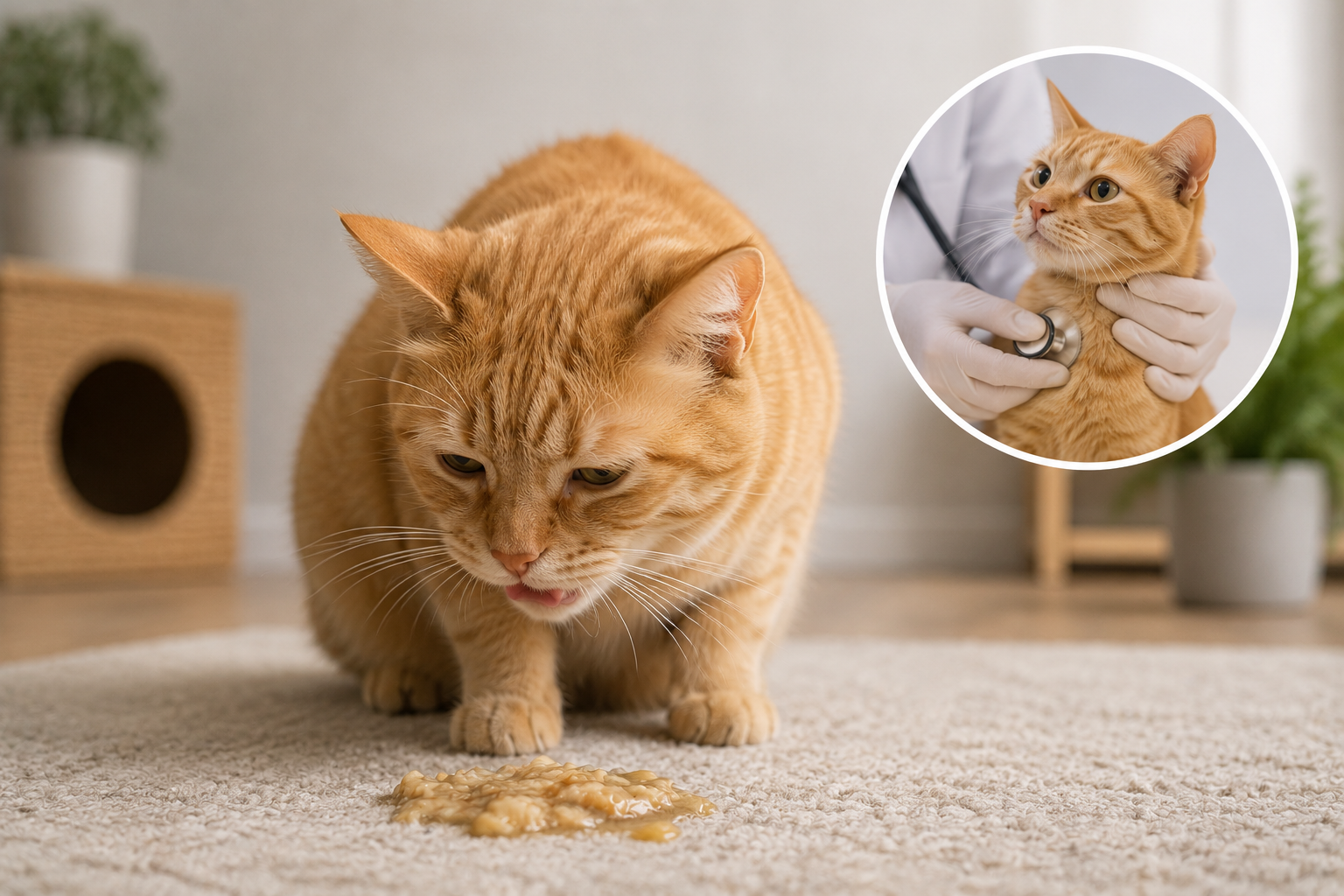
Cats can be sick for simple reasons such as eating too fast, hairballs or a sudden food change, but vomiting should never be brushed off as “just something cats do” when it becomes frequent, severe or comes with other symptoms. Yellow bile, white foam, food coming back up, blood, diarrhoea, lethargy, loss of appetite, weight loss, drinking changes, suspected poisoning or a swallowed object all change the risk level. This guide explains why cats vomit, what different types of sick may suggest, when you can monitor carefully and when you should contact a vet quickly.
There are two bad reactions to cat vomiting. The first is panic over one isolated episode when the cat is bright, eating, drinking and behaving normally. The second is worse: saying “cats are always sick” while ignoring repeated vomiting, weight loss, hiding, diarrhoea or poor appetite. That second attitude is lazy and dangerous.
Vomiting is not a diagnosis. It is a sign. Sometimes the cause is mild and temporary. Sometimes it points to gastrointestinal disease, parasites, infection, kidney disease, liver disease, pancreatitis, thyroid problems, poisoning, a swallowed object or another condition that needs proper veterinary attention. The smart approach is not to guess. The smart approach is to look at the pattern, the contents, the colour, the frequency and the cat’s overall condition.
What Does It Mean When a Cat Is Being Sick?
Vomiting is the active forceful emptying of stomach or upper intestinal contents through the mouth. In cats, it often comes with signs of nausea before anything comes up: lip licking, drooling, repeated swallowing, restlessness, crouching, abdominal contractions or retching.
But not everything that comes out of a cat’s mouth is true vomiting. Some cats regurgitate food instead. That distinction matters because the likely causes can be different.
Vomiting vs Regurgitation
- Vomiting: usually involves nausea, retching, abdominal effort and partly digested material.
- Regurgitation: is usually more passive and often brings up undigested food soon after eating.
- Vomiting may include: yellow fluid, white foam, digested food, hair, bile or blood.
- Regurgitation may suggest: fast eating, oesophageal issues or food not properly reaching the stomach.
If your cat eats and then immediately brings up whole, barely digested food without much retching, that may not be classic vomiting. Do not ignore it, but describe it accurately to your vet. A short video or photo of the episode and the material can be useful if the problem repeats.
Why Is My Cat Being Sick?
Cats vomit for many reasons. A shallow answer like “hairball” or “bad food” is not enough. The cat’s age, vomiting frequency, colour, appetite, stool, drinking pattern, weight, food history, access to plants, access to medicines, grooming behaviour and general attitude all matter.
Common causes include:
- Eating too quickly
- Eating too much at once
- Sudden food changes
- Hairballs
- Food intolerance or sensitivity
- Parasites
- Infections
- Gastritis or intestinal inflammation
- Swallowed foreign objects
- Poisoning
- Kidney disease
- Liver or bile-related disease
- Pancreatitis
- Hyperthyroidism, especially in older cats
- Stress
- Medication side effects
- Kitten illness, parasites or feeding mistakes
A one-off episode in a cat that is otherwise completely normal may be monitored carefully. But repeated vomiting, weekly vomiting, vomiting with other symptoms or vomiting in a kitten, elderly cat or chronically ill cat should be taken more seriously.
My Cat Is Throwing Up Food
“Cat throwing up food” is one of the most common searches because owners often see their cat eat, then bring food back up soon after. Sometimes this is linked to eating too fast. Sometimes it is regurgitation. Sometimes it is a sign of a bigger digestive problem.
Possible reasons include:
- Eating too fast: the stomach is overloaded before it can cope.
- Large portions: some cats do poorly with one big meal.
- Sudden food change: the digestive system reacts badly to a fast switch.
- Food sensitivity: some ingredients may trigger vomiting, diarrhoea or skin issues.
- Regurgitation: undigested food may come back up passively shortly after eating.
- Underlying disease: repeated food vomiting can be linked to gastrointestinal or systemic illness.
If your cat seems well and the main issue is fast eating, try smaller meals, a slow feeder, puzzle feeder or spreading food across a wider surface. If the cat is lethargic, losing weight, refusing food, vomiting repeatedly or has diarrhoea, changing the bowl is not the solution. The solution is veterinary advice.
If food choice may be part of the problem, read how to choose the best cat food. But do not spend months randomly switching foods while your cat keeps being sick. That is not a plan.
Are Cat Hairballs Normal?
Cats groom themselves and swallow hair. Some of that hair passes through the digestive system. Sometimes it forms a hairball and comes back up. An occasional hairball may not be a crisis, especially in a long-haired cat or during heavy shedding periods. But frequent hairball vomiting is not something to normalise.
Hairballs are more common in:
- Long-haired cats
- Cats that shed heavily
- Cats that are not brushed enough
- Cats that overgroom
- Cats with skin irritation or parasites
- Stressed cats that lick excessively
- Cats with slower gut movement
The important point is this: a hairball is an outcome, not the whole explanation. Why is the cat swallowing so much hair? Is the coat neglected? Is the cat itchy? Is there stress? Are fleas involved? Is the cat overgrooming because of pain or anxiety?
If your cat is bringing up hairballs often, straining without producing a hairball, losing weight, eating less or seeming uncomfortable, do not treat it like a grooming inconvenience. It needs assessment.
Cat Being Sick Yellow Liquid or Bile
Yellow vomit often suggests bile or bile-stained fluid. It can happen when the stomach is empty, when the stomach lining is irritated or when there is a digestive problem. But “yellow bile” should not be automatically dismissed as “just hunger”.
Possible causes include:
- Going too long without food
- Stomach acid irritation
- Bile reflux or bile-stained vomiting
- Gastritis
- Food routine disruption
- Parasites
- Infection
- Liver, gallbladder or pancreatic problems
- Foreign object ingestion
- Poisoning
If a cat vomits yellow liquid once, then eats, drinks, uses the litter tray and behaves normally, careful monitoring may be reasonable. But repeated yellow vomiting, poor appetite, lethargy, diarrhoea, hiding, abdominal pain or inability to keep water down are different. That is when “wait and see” becomes a weak decision.
Cat Being Sick White Foam
White foam usually means there is little food in the stomach and the cat is bringing up foamy gastric fluid or saliva mixed with stomach contents. It can be linked to nausea, an empty stomach, gastritis or irritation. But again, do not use one explanation for every cat.
Possible causes of white foam include:
- Nausea on an empty stomach
- Gastric irritation
- Hairball-related retching
- Sudden food change
- Foreign object ingestion
- Poison exposure
- Kidney, liver or metabolic disease
- Severe nausea from another underlying condition
If the white foam happens once and the cat is bright afterwards, monitor closely. If your cat keeps bringing up foam, cannot eat, cannot keep water down, drools, hides, seems painful or becomes weak, contact a vet. Do not give human stomach tablets, bicarbonate, milk, oils or random home remedies.
Cat Vomiting Blood
Blood in vomit is a red flag. It may look bright red, pinkish, streaked, dark brown or like coffee grounds. The source might be the mouth, throat, stomach or intestines, but you should not casually guess at home.
Possible causes include:
- Severe stomach or intestinal irritation
- Ulcers
- Foreign object injury
- Poisoning
- Clotting problems
- Trauma
- Severe infection
- Mouth, tooth or throat bleeding
If you see blood in your cat’s sick, especially with lethargy, pale gums, collapse, diarrhoea, repeated vomiting or suspected poisoning, do not sit there refreshing search results. Call a vet.
Kitten Vomiting: Why It Is More Risky
Vomiting in kittens is more concerning than vomiting in many healthy adult cats. Kittens can become dehydrated faster, lose energy faster and be hit harder by parasites, infections and feeding mistakes. Their immune system is still developing, and small bodies have less margin for error.
Common causes in kittens include:
- Sudden food changes
- Incorrect feeding
- Parasites
- Viral or bacterial infections
- Swallowed objects
- Poisoning
- Eating too quickly
- Problems during weaning
If a kitten vomits more than once, has diarrhoea, refuses food, seems cold, weak, bloated, dull or has eye or nose discharge, do not handle it casually. Kittens can deteriorate quickly.
If your kitten is newly adopted, pair this page with the kitten care guide and what should be done at the first vet visit.
When Is Cat Vomiting Serious?
This is the part owners actually need. The real question is rarely just “why is my cat being sick?” It is “do I need to call the vet now?”
Contact a vet quickly if:
- Your cat vomits more than once in a day
- Vomiting continues or repeats over 24 hours
- There is blood in the vomit
- Your cat is lethargic, hiding or unresponsive
- Your cat refuses food
- Your cat cannot keep water down
- Vomiting comes with diarrhoea
- There is abdominal swelling or pain
- You suspect a swallowed object
- You suspect poisoning
- The cat is a kitten, elderly or has a chronic illness
- There is weight loss
- Drinking or urination has changed
- The vomiting is becoming weekly or frequent
A single mild episode in a cat that is completely normal may be monitored. Repeated vomiting or vomiting with other symptoms is not a “cat thing”. It is a veterinary problem until proven otherwise.
What Can I Give My Cat for Vomiting at Home?
This question is searched constantly, but the answer has to be blunt: do not give random things to a vomiting cat. Do not give human anti-sickness medicine, painkillers, antibiotics, milk, yoghurt, bicarbonate, olive oil, herbal mixtures or anything from a comment section. Cats are sensitive to many substances, and some human medicines can be dangerous or fatal.
If the cat vomited once, is bright, eating, drinking and behaving normally, the safest home action is careful monitoring, access to fresh water and a calm environment. If the vomiting repeats or the cat seems unwell, home fixes are not the answer.
Before calling your vet, note:
- When the vomiting started
- How many times it happened
- Whether it happened before or after food
- Whether the sick contained food, hair, foam, yellow fluid or blood
- Whether your cat is eating
- Whether your cat is drinking
- Whether there is diarrhoea
- Whether litter tray habits changed
- Whether there was a new food, medicine, plant or cleaning product exposure
- Whether your cat could have swallowed string, tinsel, toy parts or another object
- Your cat’s age and any known medical conditions
That information is far more useful than saying “my cat was sick, what do I do?” A vet can triage much better when the facts are clear.
Poisoning and Cat Vomiting
Vomiting can be one of the first signs of poisoning. Cats may be exposed to toxic plants, human medicines, cleaning products, insecticides, rodenticides, antifreeze, chocolate, onion, garlic, alcohol, essential oils or inappropriate flea and tick products.
Possible poisoning signs include:
- Repeated vomiting
- Drooling
- Tremors
- Seizures
- Weakness or collapse
- Breathing difficulty
- Abnormal pupil changes
- Bloody diarrhoea or bloody vomit
- Wobbliness or disorientation
If poisoning is possible, do not try to make your cat sick at home. That can make things worse. Use pet poisoning symptoms and first aid as a quick reference, but contact a vet immediately if exposure is likely or signs are present.
Vomiting and Diarrhoea Together
Vomiting and diarrhoea together raise the risk level because fluid loss can develop faster. This matters even more in kittens, elderly cats, thin cats, cats with kidney disease, diabetic cats or cats with unclear vaccination and parasite history.
Possible causes include:
- Gastroenteritis
- Food upset or sudden diet change
- Parasites
- Infections
- Poisoning
- Foreign body obstruction
- Pancreatic or liver disease
- Inflammatory bowel disease
One soft stool and one vomit in a bright cat is one thing. Repeated vomiting with diarrhoea, blood, weakness or poor appetite is another. Do not pretend they are the same.
Vomiting and Not Eating
Loss of appetite in cats matters. When it comes with vomiting, it matters even more. Cats that do not eat for a prolonged period can develop serious metabolic problems, and overweight cats can be particularly at risk if they stop eating for too long.
If your cat vomits once, then eats normally, drinks, plays and does not vomit again, monitoring may be enough. If your cat sniffs food and walks away, hides, refuses multiple meals, seems weak or keeps vomiting, waiting is a bad plan.
Vomiting in Older Cats
Vomiting in older cats should not be dismissed as “just age”. Senior cats are more likely to have underlying conditions such as kidney disease, hyperthyroidism, liver disease, pancreatitis, gastrointestinal disease, cancer or chronic inflammation.
Take vomiting in an older cat more seriously if you notice:
- Weight loss
- Drinking more than usual
- Urinating more or less than usual
- Eating more but losing weight
- Poor coat condition
- Lethargy
- Constipation or diarrhoea
- Frequent vomiting
A senior cat that vomits repeatedly may need blood tests, urine tests, imaging or other diagnostics. That decision cannot be made from a colour chart online.
What Does the Colour of Cat Sick Mean?
The colour of vomit does not diagnose the problem by itself, but it can give useful clues. Note the colour, texture and contents if the vomiting repeats.
- Yellow vomit: may suggest bile, an empty stomach or digestive irritation.
- White foam: may suggest nausea, stomach fluid, empty stomach or gastritis.
- Food: may suggest fast eating, regurgitation, food sensitivity or digestive disease.
- Hair: may suggest hairballs, but frequent hair vomiting still needs attention.
- Green vomit: may be linked to bile, plant material or gut irritation.
- Brown foul-smelling vomit: can be more concerning and needs veterinary advice, especially if repeated.
- Red or coffee-ground vomit: may suggest blood and should be treated seriously.
Colour helps, but the bigger picture matters more: how many times, how the cat looks, whether they eat, whether they drink, whether there is diarrhoea, whether they could have eaten something dangerous and whether they are young, elderly or already unwell.
How to Reduce Cat Vomiting Risk
Not every case of vomiting can be prevented. But some common triggers can be reduced with better routine and safer management.
- Slow the food down: use smaller meals, slow feeders or puzzle feeders for fast eaters.
- Avoid sudden diet changes: transition foods gradually where possible.
- Brush regularly: especially for long-haired cats and heavy shedders.
- Control hairballs properly: do not just accept frequent hair vomiting as normal.
- Remove toxic plants: cats chew plants more often than owners expect.
- Lock away medicines and cleaning products: bags, counters and cupboards are not always safe.
- Keep parasite care current: follow a veterinary plan, especially for outdoor cats or rescues.
- Monitor the litter tray: vomiting with diarrhoea, constipation or urinary changes is more concerning.
- Book routine checks: especially for senior cats or cats with recurring vomiting.
If your cat is newly adopted or has unclear medical records, the cat vaccination schedule can help you organise preventive care. But if your cat is actively vomiting, has diarrhoea or seems unwell, the immediate priority is a health check, not rushing into routine vaccines.
What Will a Vet Do for a Vomiting Cat?
A good vet does not just “stop the sick” and move on. Vomiting is a symptom. The job is to work out why it is happening and how urgent it is.
Depending on the case, a vet may consider:
- Physical examination
- Temperature, hydration and gum colour check
- Abdominal examination
- Blood tests
- Urine testing
- Faecal or parasite testing
- X-rays or ultrasound
- Fluid therapy if dehydrated
- Anti-nausea medication when appropriate
- Investigation for foreign objects or poisoning
Poisoning, obstruction, kidney disease and simple fast eating are not treated the same way. That is why guessing at home is weak.
Vomiting With Eye or Nose Discharge
If vomiting comes with eye discharge, nasal discharge, sneezing, poor appetite and lethargy, the picture may involve infection or wider illness, especially in kittens or recently adopted cats. Do not treat eye discharge as a separate cosmetic issue if the cat is also vomiting and unwell.
You can read why cats have eye discharge for the eye-specific side, but vomiting plus respiratory signs lowers the threshold for veterinary advice.
Keep a Cat Vomiting Diary
If vomiting repeats, keep a simple record. “She is sick sometimes” is too vague. A diary helps you and your vet see patterns.
Record:
- Date and time
- Before or after food
- Colour of the vomit
- Food, hair, foam, liquid or blood
- Number of episodes
- Appetite
- Water intake
- Stool quality
- Energy level
- New food, treats, medicines or stress factors
This is especially useful for chronic vomiting, suspected food sensitivity, hairballs, senior cats and cats that seem normal between episodes. Data beats vague memory.
Common Mistakes Owners Make With Cat Vomiting
- Saying “cats just vomit”: frequent vomiting is not normal.
- Blaming every episode on hairballs: even hair-related vomiting can have an underlying reason.
- Giving human medicine: some human medicines are dangerous for cats.
- Changing food repeatedly without a plan: this can worsen digestive upset.
- Ignoring blood: blood in vomit needs urgent attention.
- Underestimating kitten vomiting: kittens can deteriorate quickly.
- Trying to make the cat vomit after suspected poisoning: this can be dangerous.
- Not tracking frequency: “occasionally” is not useful if it actually means weekly.
- Ignoring lethargy and appetite loss: these change the seriousness of vomiting.
- Giving poor information to the vet: colour, timing, frequency and other symptoms matter.
Final Word: Cat Vomiting Is a Sign, Not a Normal Lifestyle
Why is my cat being sick? There is no single answer. It might be fast eating, a hairball, food change or an empty stomach. It might also be poisoning, a swallowed object, infection, parasites, kidney disease, liver disease, pancreatitis, thyroid disease or another serious problem.
The strongest approach is simple: do not panic over one mild episode in a completely normal cat, but do not normalise repeated vomiting. Watch the frequency, colour, timing, contents and the cat’s general condition. If vomiting repeats or comes with red flags, contact a vet.
Vomiting is a signal. Sometimes it is a small warning. Sometimes it is the first sign of something serious. The difference depends on the pattern, the cat and how quickly you respond.
Frequently Asked Questions
Why is my cat being sick?
Cats can be sick because of fast eating, hairballs, sudden food changes, food sensitivity, parasites, infection, stomach or intestinal disease, swallowed objects, poisoning, kidney disease, liver disease, pancreatitis or thyroid problems. A single mild episode may be monitored if the cat is otherwise normal, but repeated vomiting or vomiting with other symptoms needs veterinary advice.
When is cat vomiting serious?
Cat vomiting is serious if it happens more than once, continues over 24 hours, contains blood, comes with lethargy, diarrhoea, loss of appetite, inability to keep water down, weight loss, abdominal pain, suspected poisoning or a swallowed object. Kittens, elderly cats and cats with existing illness should be treated more urgently.
Why is my cat throwing up yellow liquid?
Yellow liquid often suggests bile or bile-stained vomit. It may happen when the stomach is empty, but it can also be linked to gastritis, digestive irritation, parasites, infection, liver, gallbladder or pancreatic problems, foreign objects or poisoning. Repeated yellow vomiting or yellow vomiting with lethargy, diarrhoea or poor appetite needs veterinary advice.
Why is my cat throwing up white foam?
White foam can appear when a cat is nauseous and there is little food in the stomach. It may be linked to an empty stomach, gastritis, hairball retching, sudden food changes, foreign objects, poisoning or underlying disease. If it repeats or your cat is lethargic, not eating, drooling or unable to keep water down, contact a vet.
Is it normal for cats to throw up food?
A cat may throw up food because of eating too fast, overeating, sudden food change, food sensitivity or regurgitation. If it is rare and the cat is otherwise well, smaller meals or a slow feeder may help. If it happens often, or there is weight loss, diarrhoea, lethargy or poor appetite, it should not be treated as normal.
Are cat hairballs normal?
Occasional hairballs can happen, especially in long-haired cats or heavy shedding periods. Frequent hairball vomiting is not normal. It may point to poor grooming control, excessive shedding, overgrooming, stress, skin irritation, parasites or digestive problems. Repeated hairball vomiting should be discussed with a vet.
What can I give my cat for vomiting at home?
Do not give human medicines, milk, yoghurt, bicarbonate, oils or herbal remedies to a vomiting cat unless a vet tells you to. If vomiting happens once and the cat is bright, eating, drinking and behaving normally, careful monitoring may be enough. Repeated vomiting or vomiting with other symptoms needs veterinary advice.
What should I do if my kitten is vomiting?
Kitten vomiting should be taken seriously because kittens can become dehydrated and weak quickly. If a kitten vomits more than once, has diarrhoea, refuses food, seems cold, dull, bloated or has eye or nose discharge, contact a vet quickly. Do not treat repeated kitten vomiting as a normal settling-in issue.
Can poisoning make a cat vomit?
Yes. Poisoning can cause vomiting in cats. Possible toxins include human medicines, cleaning products, toxic plants, insecticides, rodenticides, antifreeze, chocolate, onion, garlic, alcohol, essential oils and some inappropriate parasite products. If poisoning is possible, contact a vet immediately and do not try to make your cat vomit at home.
Is weekly cat vomiting normal?
Weekly vomiting should not be treated as normal. Hairballs, fast eating or food sensitivity may be involved, but frequent vomiting can also signal underlying disease. If your cat is sick every week, especially with weight loss, appetite change, diarrhoea, drinking changes or lethargy, book a veterinary check.