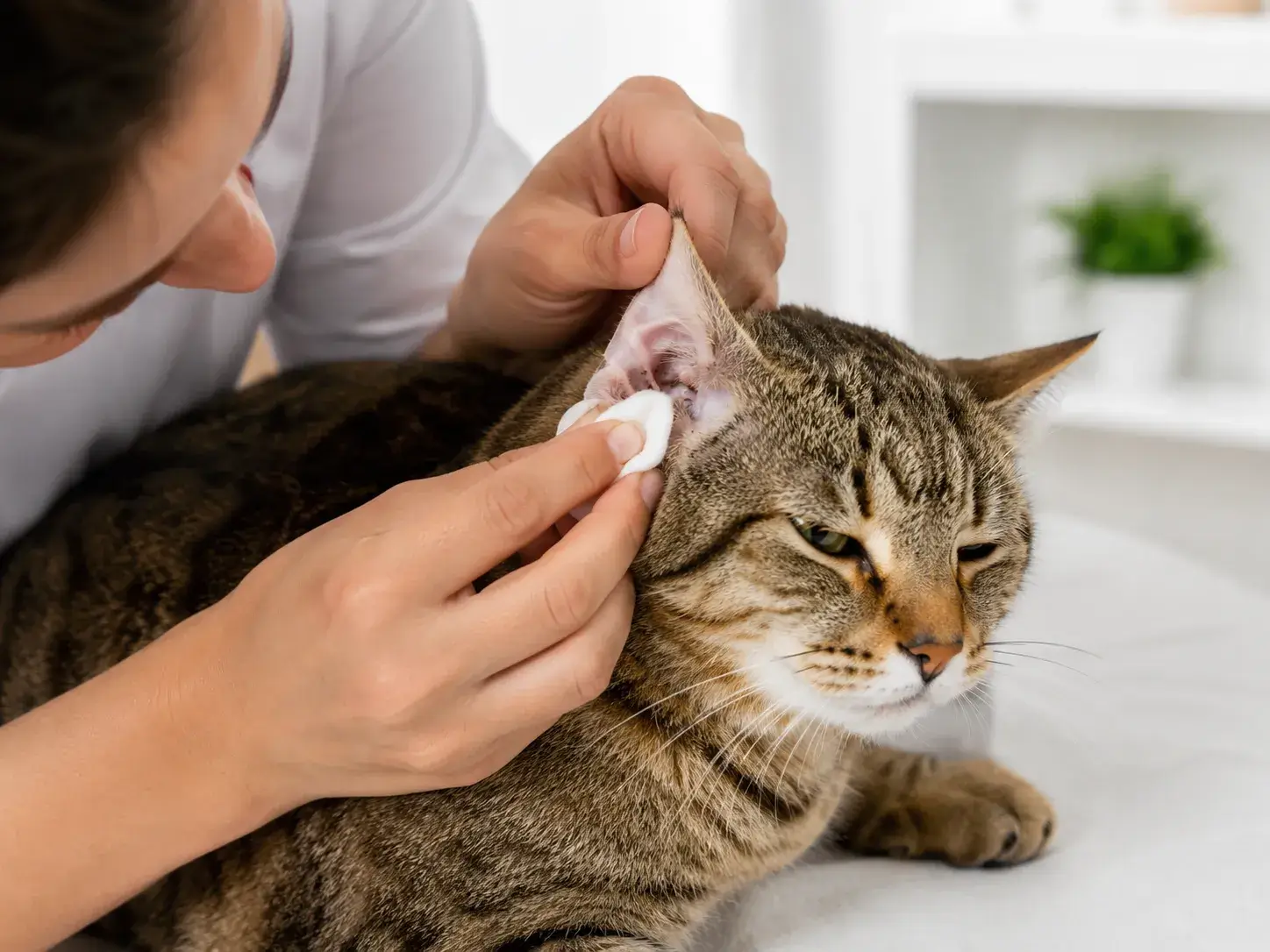
Cat ear mites, earwax and ear discharge can look similar, but they do not always mean the same thing. A small amount of pale yellow or light brown, odourless wax may be normal, while dark brown or black, dry debris that resembles coffee grounds can be associated with ear mites. Wet, yellow, green, bloody or foul-smelling discharge may point to an ear infection, irritation, injury, a foreign object, a polyp or another underlying ear problem. Colour alone cannot confirm the cause. If your cat keeps scratching their ears, shaking their head, rubbing their face, avoiding touch, developing a swollen earflap or holding their head to one side, they should be checked by a vet. This guide explains what normal cat earwax looks like, how ear mites differ from ear infections, why kittens and multi-pet households can be at higher risk, how vets diagnose ear disease, which home remedies should be avoided, how to check and clean a cat’s ears safely and which symptoms require urgent veterinary care.
One of the most common mistakes is assuming that every dirty-looking ear contains mites. Black or dark brown debris can make ear mites more likely, particularly when it is dry, crumbly and accompanied by intense itching. However, yeast, bacteria, dried blood, excessive wax and chronic inflammation can create a similar appearance. A cat can also have ear mites and a secondary ear infection at the same time.
The safest approach is not to choose a random ear treatment based on the colour of the wax. The vet needs to consider how long the problem has been present, whether one or both ears are affected, whether the ear is painful, what the discharge looks and smells like, whether other pets are affected and whether your cat has developed balance or hearing changes.
Are Ear Mites, Earwax and Ear Discharge the Same Thing?
No. Although cat owners often use these terms interchangeably, they describe different things.
- Earwax: A natural secretion that helps protect the ear canal. It may contain oils, shed skin cells and small amounts of environmental debris.
- Ear mites: Tiny parasites, most commonly Otodectes cynotis, that live on the surface of the ear canal and cause irritation and itching.
- Ear discharge: Abnormal fluid, wax or debris coming from the ear. It can be caused by mites, bacteria, yeast, inflammation, injury, a foreign object, a polyp or another ear condition.
Ear mites can cause increased wax and discharge, but not every waxy ear has mites. An ear infection may also develop after mites have irritated the ear canal, which means more than one problem can be present.
What Should a Healthy Cat’s Ears Look Like?
A healthy cat’s earflaps are normally clean and pale pink inside. There should be no marked redness, swelling, strong smell, thick discharge or obvious pain. Some cats have a small amount of visible wax at the entrance to the ear canal, while others have almost none.
A healthy ear will usually have:
- pale pink skin inside the earflap;
- little or no visible debris;
- no strong, sour or foul odour;
- no wet or sticky discharge;
- no obvious swelling or heat;
- no sores, scabs or bleeding;
- no pain when the outer ear is gently touched;
- no repeated scratching or head shaking;
- a similar appearance in both ears.
Normal varies slightly between cats. The more useful question is whether the ear has changed. A sudden increase in wax, a new smell, redness, pain or discharge is more important than comparing your cat with photographs of another cat online.
What Does Normal Cat Earwax Look Like?
Normal cat earwax is usually present in only a small amount. It may be pale yellow, tan or light brown and can feel slightly oily. It should not fill the ear canal, return rapidly after cleaning or cause constant itching.
Earwax is more likely to be normal when it:
- forms only a thin film near the ear entrance;
- is pale rather than very dark;
- has no unpleasant smell;
- does not contain blood or pus;
- does not make the ear red or swollen;
- does not cause repeated head shaking;
- does not quickly build up again after being removed.
If an ear becomes heavily soiled again within a few days, the problem is unlikely to be solved by repeated cleaning. Continued wax production can be a sign that the ear canal is inflamed.
What Are Ear Mites in Cats?
Ear mites are tiny parasites that live on the skin lining a cat’s ear canal. The species most commonly involved is Otodectes cynotis. These mites feed on wax, skin oils and surface debris, causing irritation and inflammation.
Ear mites can affect cats of any age but are particularly common in:
- kittens;
- cats recently taken in from outdoors;
- cats from rescue centres or crowded environments;
- cats living in multi-cat households;
- cats that have close contact with unfamiliar animals;
- cats living with an affected dog or ferret;
- cats without an appropriate parasite-control plan.
The term “ear mange” is sometimes used for an ear mite infestation, but it is not the most common wording used by UK cat owners. Ear mites are also different from other types of mites that affect the skin elsewhere on the body.
What Are the Symptoms of Ear Mites in Cats?
Ear mites are usually very itchy. Some cats develop severe irritation even when only a small number of mites are present, while others may show less dramatic symptoms.
Possible signs of cat ear mites include:
- scratching the ears repeatedly;
- shaking the head more than usual;
- rubbing the head or face against furniture;
- dark brown or black earwax;
- dry debris that resembles coffee grounds;
- red or inflamed ears;
- a bad smell from the ear;
- soreness when the ear is touched;
- small scratches or scabs around the ear;
- hair loss around the ears caused by scratching;
- restlessness or interrupted sleep;
- a swollen earflap if an aural haematoma develops.
A coffee-ground appearance is a useful clue, but it is not proof. A vet may need to look at a sample under a microscope before confirming that mites are present.
Is Black Earwax in Cats Always Ear Mites?
No. Black earwax is commonly associated with ear mites, but it can have several other causes. Diagnosing mites from colour alone is unreliable.
Possible causes of black or very dark ear debris include:
- ear mites;
- yeast overgrowth;
- a bacterial or mixed ear infection;
- dried blood caused by scratching;
- concentrated or excessive earwax;
- chronic inflammation of the ear canal;
- a foreign object causing irritation;
- a polyp or other growth inside the ear.
Ear mites become more likely when the black wax is dry and crumbly, the cat is extremely itchy and both ears are affected. A wet, greasy or strongly smelling discharge may make infection more likely. These are only clues, not a home diagnosis.
Why Does My Cat Have Coffee-Ground-Like Debris in Their Ears?
Dark, dry and crumbly debris that looks like coffee grounds is one of the classic descriptions associated with ear mites. The material can contain wax, shed skin, inflammatory debris and small amounts of dried blood produced by irritation and scratching.
Ear mites should be considered more strongly when:
- the cat is scratching intensely;
- the cat repeatedly shakes their head;
- both ears contain similar dark debris;
- another cat or dog in the household is also scratching;
- the cat is a kitten;
- the cat has recently come from a rescue centre, cattery or outdoor environment;
- the debris returns soon after cleaning;
- there are scratches or scabs around the earflaps.
Because infections and dried blood can create a similar appearance, a vet should examine the ear rather than treatment being selected from a photograph.
Why Is Brown Wax Building Up in My Cat’s Ear?
Brown wax may be normal when there is only a small amount and the ear is comfortable, clean-smelling and pale pink. A heavy or rapidly recurring brown build-up can be caused by mites, yeast, bacteria, inflammation or dried blood.
When assessing brown earwax, consider:
- whether it is pale brown or almost black;
- whether it is dry, greasy, wet or sticky;
- whether the ear smells unpleasant;
- whether the cat is scratching or shaking their head;
- whether the skin is red, hot or swollen;
- whether one or both ears are affected;
- how quickly the wax comes back after cleaning;
- whether touching the ear causes pain.
Persistent brown discharge should not be repeatedly cleaned without finding the cause. Cleaning can temporarily improve the appearance while the underlying disease continues.
What Causes Ear Discharge in Cats?
Ear discharge is a symptom rather than a diagnosis. It can come from inflammation in the outer ear canal or from a more serious problem involving the middle or inner ear.
Possible causes include:
- ear mites;
- bacterial ear infection;
- yeast overgrowth;
- a combined bacterial and yeast infection;
- allergic or inflammatory skin disease;
- fleas and other parasites;
- a grass seed or another foreign object;
- water or an unsuitable product entering the ear;
- injury caused by scratching;
- over-cleaning or rough cleaning;
- an inflammatory ear polyp;
- a tumour or another growth;
- damage to the eardrum;
- middle or inner ear disease.
One-sided discharge that repeatedly returns, particularly when it is bloody, painful or seen in an older cat, deserves a thorough examination for an obstruction, polyp or growth.
What Do Different Cat Ear Discharge Colours Mean?
The colour and texture of ear discharge can provide useful clues, but they cannot reliably identify the cause without an examination.
- Pale yellow or light brown: May be normal wax when present in a small amount without smell, pain or itching.
- Dark brown or black and crumbly: Often associated with ear mites, although infection and dried blood can look similar.
- Brown and greasy: Can occur with excess wax, yeast, bacteria or chronic inflammation.
- Yellow or green: May suggest pus and an active infection.
- Red or blood-stained: Can result from injury, severe scratching, inflammation, a foreign object, a polyp or a growth.
- Clear or watery: Can follow irritation or moisture exposure but still needs assessment if it persists.
The smell, pain level, speed of recurrence and behaviour of the cat are just as important as the colour.
What Does Yellow or Green Discharge from a Cat’s Ear Mean?
Yellow, yellow-green or thick creamy discharge may be associated with an infected ear. It is often accompanied by redness, swelling, heat, soreness and a strong odour.
If you see yellow or green discharge:
- do not push cotton buds into the ear;
- do not use leftover antibiotic drops;
- do not use human ear medication;
- do not repeatedly flush the ear to hide the discharge;
- arrange a veterinary appointment promptly.
A vet may examine a sample from the ear to check whether bacteria, yeast or both are present. Different organisms can require different treatment, so choosing drops by trial and error can delay recovery.
Why Is Blood Coming from My Cat’s Ear?
Blood or blood-stained discharge from a cat’s ear is not normal. It can be caused by scratching, a wound, a foreign object, severe inflammation, damage to the eardrum, a polyp or another growth.
Seek prompt veterinary advice if:
- the bleeding continues;
- the ear is very painful;
- the ear canal looks swollen or blocked;
- the cat holds their head to one side;
- the cat is unsteady or falling;
- the earflap has suddenly swollen;
- the bleeding keeps returning from the same ear;
- the cat is middle-aged or older and has persistent one-sided discharge.
Do not insert tissue, cotton wool or a cotton bud into the canal to stop the bleeding. Material visible on the outside of the earflap can be gently dabbed with clean gauze while you contact your vet.
Why Does My Cat’s Ear Smell Bad?
A healthy cat’s ear should not have a strong, sour, yeasty, rotten or foul smell. A bad smell commonly develops when wax, bacteria, yeast, pus and inflammatory debris accumulate inside the ear.
A smelly ear is more concerning when it is accompanied by:
- brown, yellow or green discharge;
- redness or heat;
- wetness around the ear canal;
- frequent scratching;
- head shaking;
- pain when touched;
- a swollen earflap;
- matted hair around the ear;
- reduced appetite or obvious distress.
Perfumed ear products do not treat the cause of the smell. They may irritate the ear further and can make it harder to assess the original odour.
Why Is My Cat Scratching Their Ears and Shaking Their Head?
An occasional scratch or head shake can be normal. Repeated scratching, forceful head shaking or scratching hard enough to cause wounds usually means the ear is uncomfortable.
Possible causes include:
- ear mites;
- bacterial or yeast infection;
- fleas or another external parasite;
- allergic skin disease;
- a foreign object such as a grass seed;
- excess wax;
- irritation from an unsuitable cleaner;
- an injury;
- a polyp or growth;
- middle or inner ear disease.
Repeated head shaking can also damage blood vessels inside the earflap and lead to an aural haematoma. Treating the itch early reduces the risk of this painful complication.
How Do Cats Catch Ear Mites?
Ear mites commonly spread through close physical contact with an affected animal. Cats that sleep together, groom one another or share a crowded living space are particularly at risk.
Exposure can occur in:
- multi-cat households;
- rescue centres and foster homes;
- catteries and boarding facilities;
- outdoor cat colonies;
- homes where a new kitten has recently arrived;
- households where cats and dogs live together;
- shared bedding, grooming equipment or carriers.
If one pet is diagnosed, the vet will usually want to know about every cat and dog in the household. Treating only the pet with obvious symptoms can allow reinfection.
Can Indoor Cats Get Ear Mites?
Yes. An indoor-only lifestyle can reduce exposure, but it does not make ear mites impossible. A new pet, a visiting animal, a stay at a cattery or contact with another affected animal can introduce mites.
An indoor cat may be exposed if:
- a new kitten or rescue cat comes into the home;
- another household pet goes outdoors;
- the cat stays at a cattery;
- the cat temporarily stays in another home;
- foster animals are brought into the household;
- carriers, bedding or grooming equipment are shared;
- a visiting dog or cat has an untreated infestation.
Do not dismiss dark wax simply because your cat never goes outside. The appearance and symptoms still need to be assessed.
Can Cat Ear Mites Spread to Humans?
The mites that commonly affect cats are adapted to living on animals. Human infestation is extremely uncommon. In rare cases, a person in close contact with an affected animal may develop a temporary itchy skin reaction.
While a pet is being treated:
- wash your hands after handling the ears;
- avoid direct contact with discharge;
- do not allow children to touch or clean the affected ear;
- wash pet bedding as instructed by your vet;
- have other household pets assessed;
- speak to a doctor if a persistent unexplained rash develops.
The main concern is transmission between animals rather than long-term infestation in people.
Can Ear Mites Spread to Other Cats and Dogs?
Yes. Ear mites can spread between cats and dogs through close contact. Pets without obvious symptoms may still need to be assessed or treated at the same time.
Tell your vet:
- how many cats and dogs live in the home;
- whether they sleep or groom together;
- whether another pet is scratching or shaking their head;
- whether there are kittens, puppies or pregnant animals in the household;
- the approximate age and weight of each pet;
- which parasite treatments have recently been used;
- whether any animal has a chronic health condition.
Never divide a product intended for one animal between several pets. Never use a dog parasite product on a cat unless a vet has specifically confirmed that it is safe.
Ear Mites in Kittens
Kittens are particularly likely to develop ear mites, especially when they have come from outdoors, a crowded environment or a litter where several kittens are affected.
Possible signs in a kitten include:
- dark, crumbly ear debris;
- frequent head shaking;
- scratches around the ears;
- crying or becoming restless when the ears are touched;
- red or crusted earflaps;
- a foul smell or wet discharge;
- similar symptoms in littermates;
- poor sleep caused by constant itching.
Treatment must be suitable for the kitten’s age, weight and health. Giving a smaller amount of an adult product is not a safe way to create a kitten dose. For wider early-life feeding, health and home preparation, read the kitten care guide.
Ear Mites or an Ear Infection: How Can You Tell?
Ear mites and ear infections can produce similar symptoms. Ear mites can also damage the ear canal enough for a secondary bacterial or yeast infection to develop, so both may be present at once.
Features that may suggest ear mites include:
- dry, dark debris resembling coffee grounds;
- intense itching;
- both ears being affected;
- other household pets developing similar symptoms;
- the cat being a kitten or recently rescued.
Features that may suggest an ear infection include:
- wet, greasy or pus-like discharge;
- a strong unpleasant smell;
- marked redness, heat and pain;
- yellow or green discharge;
- swelling inside the ear canal;
- one ear being much worse than the other.
These differences are not reliable enough for home diagnosis. A vet may need to examine the ear canal and inspect a sample under a microscope.
How Do Vets Diagnose Ear Mites and Ear Infections?
The vet will ask when the problem began, whether one or both ears are affected, whether your cat has met other animals and which products have already been used.
The examination may include:
- checking the earflap and surrounding skin;
- looking into the ear canal with an otoscope;
- checking the eardrum when it can be seen safely;
- taking a sample of wax or discharge;
- examining the sample for mites, yeast and bacteria;
- performing a culture in persistent or unusual infections;
- checking for a foreign object, polyp or growth;
- investigating the middle or inner ear if balance signs are present.
A very painful cat or an ear canal blocked with discharge may require sedation so the ear can be examined and cleaned without causing further distress or injury.
Should I Clean My Cat’s Ear Before the Vet Appointment?
If there is heavy discharge, black debris, blood or a strong smell, ask the veterinary practice before cleaning. Washing the ear immediately before the appointment can remove material that the vet may want to examine.
Before the appointment:
- take clear photographs in good light;
- note when the symptoms began;
- record whether one or both ears are affected;
- write down any changes in balance or hearing;
- bring the packaging of products already used;
- do not insert a cotton bud into the canal;
- do not flush the ear unless your vet tells you to;
- gently wipe only material already sitting on the outside of the earflap.
If this is your cat’s first appointment or you have recently adopted them, the first vet visit guide can help you prepare the information your vet may need.
How Are Ear Mites in Cats Treated?
Treating ear mites involves killing the mites, relieving inflammation and dealing with any secondary infection. Cleaning visible wax alone will not eliminate the infestation.
A veterinary treatment plan may include:
- a cat-safe antiparasitic treatment;
- a prescribed spot-on product;
- medicated ear drops when required;
- a veterinary ear cleaner;
- pain relief or anti-inflammatory treatment;
- treatment for a bacterial infection;
- treatment for yeast overgrowth;
- assessment or treatment of other household pets;
- cleaning bedding and grooming equipment;
- a follow-up examination.
The correct product depends on the cat’s age, weight, health and the condition of the ear. Some flea treatments also cover ear mites, but not every flea product does. Follow the instructions for the full treatment period even if the ears appear better sooner.
How Long Do Cat Ear Mites Take to Clear?
The time needed depends on the product used, the severity of the infestation, whether infection is also present and whether every exposed pet is treated correctly.
Scratching and head shaking may begin to improve before the infestation has been fully controlled. This is why treatment should not be stopped simply because the cat appears more comfortable.
During treatment:
- follow the exact application schedule;
- complete prescribed ear drops;
- do not repeat spot-on treatment early;
- treat or assess other pets as advised;
- avoid excessive cleaning;
- attend the recommended follow-up appointment;
- contact the vet if smell, pain or discharge continues.
Why Do Ear Mites Come Back After Treatment?
Recurring symptoms do not automatically mean that the mites are resistant. Several practical and medical problems can make an ear appear to relapse.
Possible reasons include:
- stopping treatment too early;
- missing a repeat treatment;
- incorrect application;
- another household pet remaining untreated;
- the cat licking or rubbing off a product;
- a secondary bacterial or yeast infection continuing;
- the original problem not actually being ear mites;
- a foreign object, polyp or growth being present;
- over-cleaning and repeatedly irritating the ear canal.
If black debris returns, do not simply repeat an old treatment. The ear may need to be sampled again to identify what remains.
How Can I Check My Cat’s Ears at Home?
A home ear check should be gentle and limited to the parts you can see. Do not try to straighten the ear canal or use a tool to look deeper.
To check the ears safely:
- choose a time when your cat is relaxed;
- use a well-lit room;
- gently lift the earflap;
- look only at the visible opening;
- check for redness, swelling, wax and discharge;
- notice whether there is an unusual smell;
- compare the two ears;
- watch how your cat reacts to gentle touch;
- take a photograph of anything unusual.
Stop if your cat appears frightened, painful or likely to bite or scratch. A forced examination can worsen pain and make future treatment more difficult.
How Do You Clean a Cat’s Ears Safely?
Most healthy cats do not need routine ear cleaning. Clean the ears only when your vet has advised it or has shown you how to manage a specific problem.
If your vet has confirmed that cleaning is appropriate:
- use a cat-safe ear cleaner recommended by your vet;
- prepare cotton wool, gloves and treats;
- place your cat on a secure, non-slip surface;
- gently lift the earflap;
- place the bottle nozzle only at the ear entrance;
- apply the amount recommended by your vet;
- massage the base of the ear gently;
- allow your cat to shake their head;
- wipe away loosened material with cotton wool;
- clean only as far as you can easily see;
- reward your cat after the procedure.
Do not pour cleaner into a red, bleeding, severely painful or swollen ear before speaking to a vet. Some products may be unsafe if the eardrum has been damaged.
Can You Clean a Cat’s Ears with Cotton Buds?
No. Cotton buds should not be pushed into a cat’s ear canal. They can compact wax, scratch the delicate skin or damage the eardrum if the cat moves suddenly.
Risks include:
- pushing debris deeper into the canal;
- causing pain and bleeding;
- worsening inflammation;
- damaging the eardrum;
- leaving cotton fibres behind;
- making an existing infection more painful.
Cotton wool or gauze can be used only to wipe the visible outer ear after wax has moved towards the entrance.
Can I Use Hydrogen Peroxide, Alcohol or Vinegar in My Cat’s Ear?
Do not put hydrogen peroxide, surgical spirit, alcohol, vinegar or another household mixture into your cat’s ear unless a vet has specifically told you to use it. Inflamed ear canals are sensitive, and household products can cause stinging, irritation and additional pain.
Avoid using:
- hydrogen peroxide;
- alcohol or surgical spirit;
- apple cider vinegar or white vinegar;
- household disinfectants;
- soap or shampoo;
- essential oils;
- strongly perfumed ear products;
- homemade herbal mixtures;
- human ear-cleaning solutions.
A product being described as natural or antiseptic does not make it suitable for a cat’s ear canal.
Does Olive Oil Kill Ear Mites in Cats?
Olive oil may soften dry wax, but it should not be treated as a reliable cure for ear mites. It does not replace an effective veterinary antiparasitic treatment and will not manage a bacterial or yeast infection.
Using oil as a home treatment can:
- delay an accurate diagnosis;
- leave greasy material inside the ear canal;
- make it harder to assess the original discharge;
- fail to control every stage of the infestation;
- leave a secondary infection untreated;
- waste time if the real cause is a polyp or foreign object.
If your vet wants the wax softened, ask which cat-safe cleaner or method should be used.
Can I Use Human or Dog Ear Drops on a Cat?
No. Do not use human ear drops, dog ear cleaner or medication prescribed for another animal unless your vet has confirmed that the exact product is safe for your cat.
Avoid using:
- human antibiotic ear drops;
- human antifungal products;
- human pain-relieving ear drops;
- dog ear cleaner;
- dog flea or mite medication;
- old medication from a previous illness;
- expired ear drops;
- creams intended for the skin;
- household insecticide.
If the wrong parasite or ear product has been applied and your cat develops severe drooling, twitching, tremors, wobbliness, being sick, seizures or collapse, contact an emergency vet immediately. Keep the packaging with you. The pet poisoning symptoms and first aid guide explains the general information to collect while arranging urgent help.
What If My Cat Licks Ear Cleaner or Ear Medication?
The risk depends on the ingredients, the quantity swallowed and whether the product was formulated for cats. Some cat-safe products taste bitter and may cause temporary drooling or lip-smacking, but this should not be assumed for every cleaner or medicine.
If your cat has licked a product:
- keep the bottle and packaging;
- estimate how much may have been swallowed;
- do not make your cat vomit;
- do not force water into their mouth;
- watch for drooling, being sick, tremors and weakness;
- call your vet if the product was not made for cats;
- seek emergency care for twitching, seizures, severe wobbliness or collapse.
Store ear products securely and avoid leaving an open bottle where the cat can reach it.
Why Is Only One of My Cat’s Ears Dirty?
Ear mites often affect both ears, although one ear can be worse. A persistent one-sided problem can also suggest a foreign object, localised infection, inflammatory polyp or another growth inside the ear canal.
One-sided discharge deserves particular attention when:
- it repeatedly returns after treatment;
- it is bloody or contains pus;
- the ear canal looks blocked;
- the cat consistently tilts their head towards one side;
- hearing appears reduced on one side;
- the cat is middle-aged or older;
- a lump or tissue can be seen at the ear entrance;
- one side of the face looks different.
Repeatedly changing ear drops without investigating the cause can allow a deeper problem to continue.
Why Has My Cat’s Earflap Suddenly Swollen?
A soft or tense swelling inside the earflap may be an aural haematoma. This is a pocket of blood that forms after a small blood vessel bursts inside the earflap, often because the cat has been shaking or scratching due to mites, infection or itchy skin.
Possible signs include:
- a soft, fluid-filled swelling;
- one ear looking much thicker than the other;
- a warm or painful earflap;
- the ear drooping because of its weight;
- continued head shaking;
- discharge or wax inside the ear canal.
Do not try to drain the swelling with a needle. This can cause infection, bleeding and permanent ear damage. The swelling and the underlying reason for the scratching both need veterinary treatment.
Why Are Head Tilt and Loss of Balance Serious?
If an ear problem is accompanied by a persistent head tilt, falling or loss of balance, the condition may involve the middle or inner ear rather than only the outer canal.
Urgent neurological signs include:
- holding the head constantly to one side;
- walking in circles;
- falling or leaning to one side;
- being unable to stand normally;
- rapid flickering eye movements;
- one side of the face drooping;
- being unable to blink one eye;
- sudden hearing changes;
- severe nausea or being sick;
- marked confusion or behaviour change.
Do not clean the ear at home when these signs are present. Contact a vet for urgent assessment.
When Is Cat Ear Discharge an Emergency?
Not every dirty ear requires an out-of-hours appointment, but some symptoms should not wait.
Seek urgent or same-day veterinary help if your cat has:
- a head tilt;
- loss of balance or repeated falling;
- rapid involuntary eye movements;
- severe or rapidly worsening pain;
- heavy or continuing bleeding;
- a suddenly swollen earflap;
- large amounts of pus;
- chemical or insecticide exposure inside the ear;
- tremors or seizures after an ear product;
- collapse or extreme weakness;
- facial weakness or inability to blink;
- ear discharge after a serious accident or head injury.
If the problem is mild but keeps returning, or your cat has been scratching for more than a short period, book a routine appointment rather than continuing home treatment.
What Information Should I Give the Vet?
A clear history can help the vet narrow down the cause. Write down the details before the appointment rather than relying on memory.
Useful information includes:
- when the symptoms began;
- which ear was affected first;
- the colour, texture and smell of the discharge;
- how often your cat scratches or shakes their head;
- whether another pet is affected;
- recent contact with outdoor cats, rescue animals or a cattery;
- the last parasite treatment used;
- the name of any ear cleaner or drops already applied;
- your cat’s age, weight and medical conditions;
- any head tilt, balance or hearing changes;
- photographs taken before the ear was cleaned.
How Can Ear Mites Be Prevented?
There is no single home-cleaning routine that guarantees prevention. Early checks, appropriate parasite control and careful management of new pets provide better protection.
Useful preventive steps include:
- having newly adopted cats examined by a vet;
- checking kittens carefully before introducing them to other pets;
- keeping new arrivals separate until parasite risks have been assessed;
- checking the visible earflaps regularly;
- acting early when dark wax or itching appears;
- following a cat-specific parasite plan;
- cleaning carriers between animals;
- washing shared bedding and grooming equipment;
- having all exposed household pets assessed;
- finishing the prescribed treatment course.
Some cat parasite products cover ear mites while others do not. For a wider UK-focused plan covering fleas, ticks, worms and mites, read the cat flea, tick and worming schedule.
How Often Should You Clean a Cat’s Ears?
There is no universal weekly or monthly ear-cleaning schedule for cats. Many healthy cats do not need their ears cleaned at all. Unnecessary cleaning can irritate the ear canal and interfere with its natural protective environment.
The need for cleaning depends on:
- whether your cat has a current ear condition;
- whether your vet has prescribed a treatment routine;
- how much wax your cat naturally produces;
- whether ear problems have repeatedly returned;
- the product being used;
- whether an underlying skin condition is present;
- how your cat tolerates the procedure.
Checking the ears regularly is different from cleaning them regularly. Look for changes, but do not clean a healthy ear simply because a date has appeared on the calendar.
Why Does the Earwax Come Back Straight After Cleaning?
Heavy wax that returns shortly after cleaning usually means the underlying inflammation is still active. Repeated cleaning may remove the visible result without controlling the cause.
Rapid recurrence can be linked to:
- untreated ear mites;
- bacterial infection;
- yeast overgrowth;
- incomplete treatment;
- irritation from an unsuitable cleaner;
- a foreign object;
- a polyp or growth;
- chronic allergic or inflammatory skin disease.
If the ear keeps filling with debris, book a recheck instead of increasing how often you clean it.
Can Ear Mites Affect a Cat’s Hearing?
Heavy wax, swelling and inflammation can block the ear canal and temporarily reduce hearing. If untreated disease spreads towards the middle or inner ear, hearing and balance may be affected more seriously.
Possible signs of reduced hearing include:
- failing to respond to familiar sounds;
- sleeping through noises that previously caused a reaction;
- being easily startled when approached from behind;
- meowing more loudly than usual;
- turning one side of the head towards sounds;
- hearing changes accompanied by balance problems.
Hearing changes require an examination. Cleaning the visible wax may not address disease deeper inside the ear.
Do Cat Ear Mites Go Away on Their Own?
Ear mites should not be expected to disappear without effective treatment. Symptoms may fluctuate, but the mites can continue irritating the ears and spreading to other animals.
Untreated ear mites can lead to:
- ongoing pain and itching;
- scratches, wounds and bleeding;
- a secondary bacterial or yeast infection;
- chronic inflammation;
- thickening of the ear canal;
- an aural haematoma;
- hearing changes;
- middle or inner ear complications;
- transmission to other pets.
Even if the ear appears cleaner, complete the plan provided by your vet and attend a follow-up examination when advised.
Common Myths About Cat Ear Mites and Dirty Ears
- “Black wax always means ear mites.” Not necessarily. Infection, excessive wax and dried blood can look similar.
- “Indoor cats cannot catch ear mites.” False. New pets and close animal contact can introduce them.
- “Every cat’s ears should be cleaned weekly.” False. Most healthy cats do not need routine cleaning.
- “Cotton buds remove the dirt properly.” They can push material deeper and damage the ear.
- “Olive oil cures ear mites.” It may soften wax but does not replace veterinary treatment.
- “Human ear drops are safe in a smaller dose.” They should not be used unless a vet confirms the exact product is appropriate.
- “Only the pet with symptoms needs treatment.” Other cats and dogs in the household may also need assessment.
- “Every flea spot-on treats ear mites.” Products have different parasite coverage.
- “The treatment can stop when the itching stops.” Improvement does not prove that the infestation or infection has fully cleared.
Summary: When Should You Worry About Your Cat’s Earwax or Discharge?
A small amount of pale, odourless wax may be normal. Dark brown or black, coffee-ground-like debris combined with intense scratching and head shaking can suggest ear mites. Wet, greasy, yellow, green, bloody or foul-smelling discharge may indicate an infection or another ear problem.
Wax colour cannot provide a definite diagnosis. A vet may need to examine the canal with an otoscope and inspect a sample under a microscope for mites, yeast and bacteria. Persistent one-sided discharge may also require investigation for a foreign object, polyp or growth.
Do not put cotton buds, peroxide, alcohol, vinegar, human medication or dog products into the ear. Seek urgent veterinary help if your cat develops a head tilt, loss of balance, rapid eye movements, severe pain, heavy bleeding, a swollen earflap, tremors or seizures after treatment.
Frequently Asked Questions
Does black earwax mean my cat has ear mites?
Black or dark brown, crumbly earwax can suggest ear mites, especially if your cat is scratching and shaking their head. However, yeast, bacteria, excessive wax and dried blood can look similar. A vet may need to examine a sample under a microscope before confirming the cause.
What colour should normal cat earwax be?
Normal cat earwax is usually present in only a small amount and may be pale yellow, tan or light brown. It should not smell unpleasant or cause redness, pain, repeated scratching or head shaking. Heavy black, wet, green, bloody or foul-smelling discharge is not normal.
What do ear mites look like in a cat’s ear?
The mites themselves are extremely small and are difficult to see without magnification. The more noticeable sign is often dark brown or black, dry debris resembling coffee grounds. Cats may also scratch their ears, shake their head and develop redness or a bad smell.
Can indoor cats get ear mites?
Yes. Indoor cats have a lower exposure risk but can still catch ear mites from a new kitten, another household pet, a visiting animal, a cattery or shared bedding and grooming equipment. Indoor living does not completely rule out ear mites.
Are cat ear mites contagious to other pets?
Yes. Ear mites can spread between cats and dogs through close contact. If one pet is diagnosed, other cats and dogs in the home may need to be assessed or treated at the same time, even when they are not showing obvious symptoms.
Can cat ear mites spread to humans?
Long-term human infestation is extremely rare. Occasionally, close contact with an affected animal may cause a temporary itchy skin reaction. Wash your hands after handling the ears and speak to a doctor if an unexplained persistent rash develops.
Can I clean my cat’s ears with cotton buds?
No. Cotton buds can push wax further into the ear canal, scratch the skin or damage the eardrum. Only wipe material that has moved to the visible entrance of the ear, using cotton wool or gauze and a cat-safe cleaner recommended by your vet.
Can I clean my cat’s ears with hydrogen peroxide?
Hydrogen peroxide should not be put into a cat’s ear unless a vet specifically instructs you to use it. It can sting and irritate an inflamed or damaged ear canal. Use only a cat-safe ear cleaner recommended for your cat.
Does olive oil get rid of cat ear mites?
Olive oil may soften wax but it is not a reliable treatment for ear mites. It will not treat a bacterial or yeast infection and may delay diagnosis. Cats with suspected mites need an effective, cat-safe antiparasitic treatment selected by a vet.
Why does my cat have smelly brown ear discharge?
Smelly brown discharge can be associated with ear mites, bacterial infection, yeast or chronic inflammation. A bad smell, pain, redness and wet discharge make veterinary assessment important. The colour and smell cannot identify the exact organism without examination.
Why is yellow discharge coming from my cat’s ear?
Yellow or yellow-green discharge may contain pus and can suggest an active ear infection. Do not use leftover antibiotics or human ear drops. A vet may need to inspect the discharge for bacteria and yeast before choosing treatment.
How long does it take to treat ear mites in cats?
The time varies with the treatment, severity of the infestation and whether infection is also present. Itching may improve before all mites have been controlled. Follow the full treatment schedule and do not stop or repeat a product early without veterinary advice.
Do cat ear mites go away without treatment?
Ear mites should not be expected to disappear on their own. They can continue causing pain and itching, spread to other pets and lead to wounds, secondary infection or a swollen earflap. Appropriate veterinary treatment is required.
How often should I clean my cat’s ears?
Most healthy cats do not need routine ear cleaning. Check the ears regularly, but clean them only when your vet has advised it. Frequent unnecessary cleaning can irritate the ear canal and may make recurring ear problems worse.
When is a cat ear problem an emergency?
Seek urgent veterinary help if your cat has a head tilt, loss of balance, rapid eye movements, severe pain, heavy bleeding, a suddenly swollen earflap, facial weakness, collapse, tremors or seizures after an ear or parasite product.