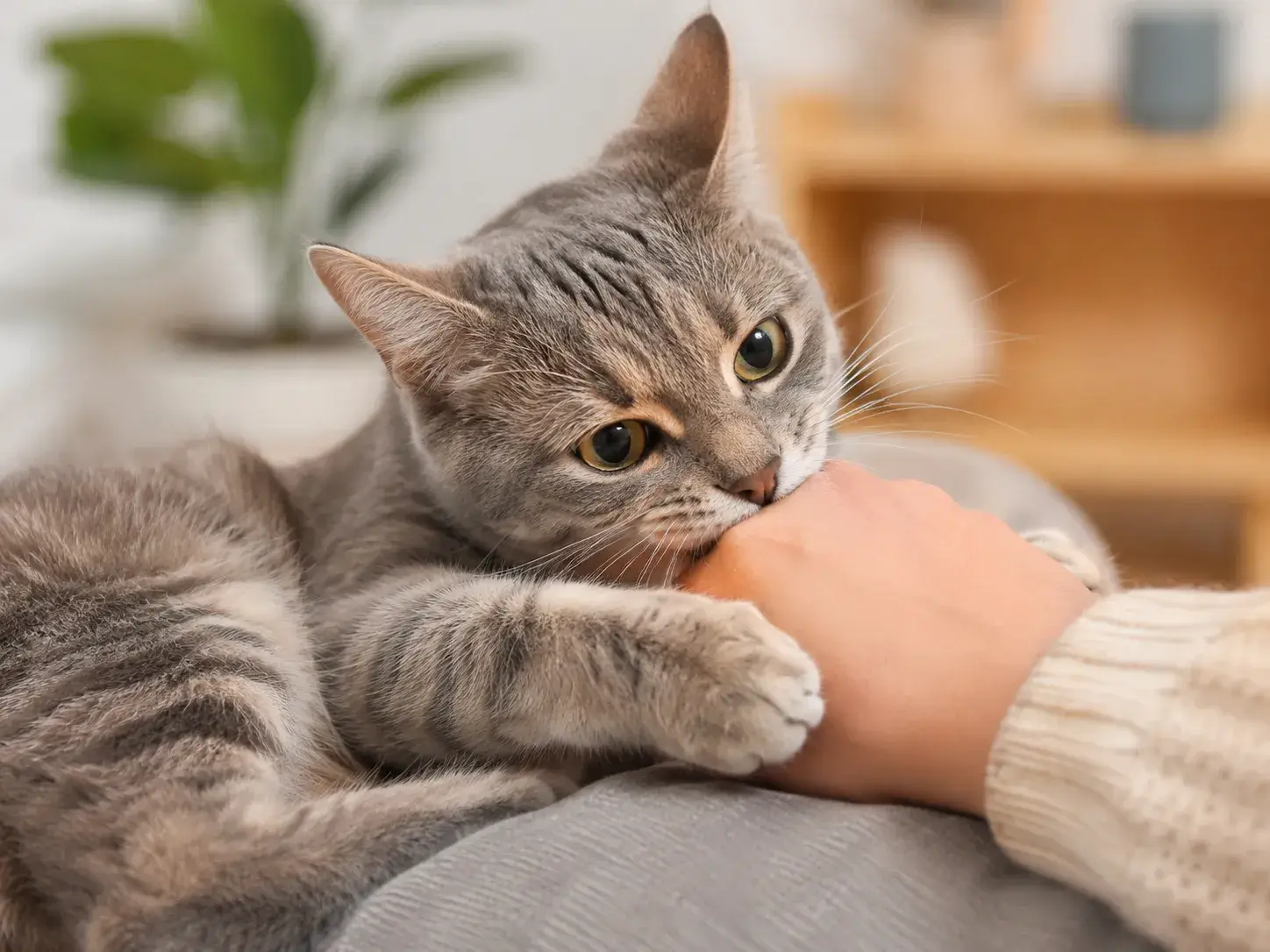
Why do cats bite? There is no single answer. A cat may bite because they are playing, overstimulated, fed up with being stroked, frightened, defending themselves, stressed, redirecting hunting behaviour, teething, in pain or dealing with a health problem. Some bites are light play nips, but others are warning signs that should not be ignored. If your cat suddenly starts biting, bites when you stroke them, attacks hands or feet, bites in the litter tray, reacts when touched, seems tense, hides more, stops eating, is being sick, has diarrhoea, struggles to wee or the bite breaks human skin, the cause needs careful attention. This guide explains why kittens bite, why cats bite during play, why cats bite when being stroked, what “love bites” really mean, how fear, stress, pain and illness can trigger biting, how to stop a cat biting safely, and what to do if a cat bite breaks the skin.
A cat bite does not automatically mean your cat is “nasty” or “badly behaved”. Cats often bite after giving smaller signals first: a twitching tail, flattened ears, a tense body, dilated pupils, skin rippling along the back, a paw pushing your hand away, trying to leave, hissing, growling or turning the head quickly towards your hand. When those signals are missed, the bite becomes the louder message.
The right response is not to punish the cat. It is to understand the situation. Did the bite happen during play, while being stroked, when being picked up, near the food bowl, in the litter tray, after another cat appeared outside, after moving home or after a sudden change in health? The answer changes the solution completely.
What Does It Mean When a Cat Bites?
Cats use biting for several reasons. It can be part of play, a hunting response, a boundary, a defensive reaction, a stress signal or a response to pain. The meaning depends on the intensity of the bite, what happened just before it and how the rest of the cat’s body looked.
A cat may bite to communicate:
- “I want to play.”
- “Your hand looks like prey.”
- “That stroking is too much now.”
- “Do not pick me up.”
- “I am scared.”
- “I feel trapped.”
- “I am stressed.”
- “Something hurts.”
- “Do not touch that part of my body.”
- “I am frustrated by something I cannot reach.”
- “Another cat, dog or person is making me feel unsafe.”
- “I have too much energy and no proper outlet.”
Before asking how to stop biting, ask what your cat was trying to achieve. A kitten biting during play needs a different plan from an elderly cat biting when touched. A cat biting your feet at night needs a different plan from a cat biting in the litter tray.
Is Cat Biting Always Aggression?
No. Not every bite is true aggression. Some cats use light nips during play. Some give a small warning bite when they have had enough stroking. Kittens naturally bite and wrestle during play with littermates. The problem begins when the target becomes human hands, arms, ankles or feet.
Cat bites can be roughly grouped into:
- Play bites: Usually happen during chasing, pouncing, wrestling or high-energy play.
- Warning bites: Often mean “stop”, “too much” or “give me space”.
- Defensive bites: Usually happen when a cat feels trapped, scared or forced.
- Pain-related bites: Happen when touching, lifting or handling causes discomfort.
- Serious bites: Break the skin, are repeated, are paired with hissing or growling, or happen with a tense body and clear distress.
Even a light bite should not be encouraged as a cute habit. A small kitten bite may not hurt much, but an adult cat with the same habit can injure skin and make handling difficult.
Why Do Kittens Bite?
Kittens bite because they are learning. They explore the world with their mouth, practise hunting, wrestle, test boundaries, chase movement and sometimes bite because their gums are uncomfortable while their teeth are developing. Kitten biting is usually not malicious, but it needs direction early.
Common reasons kittens bite include:
- natural play behaviour;
- hunting practice;
- teething discomfort;
- too much unused energy;
- hands and feet being used as toys;
- being separated from littermates early;
- not learning bite control through play with other kittens;
- boredom;
- not having enough suitable toys;
- overexcitement.
If your kitten bites your hand, do not wave your fingers around to make the game more exciting. Do not wrestle with your hand. Pause the interaction, keep calm and redirect the kitten onto a wand toy, soft kicker toy or safe chew toy. The lesson should be simple: toys are for biting, hands are not.
Kittens need daily play, routine and safe outlets for their energy. If your kitten is biting a lot, pair this guide with the kitten care guide so the wider routine is also right.
Why Do Cats Bite During Play?
Play is a safe version of hunting. A cat may stalk, chase, pounce, grab, bite and kick with the back legs. That is normal when the target is a toy. It becomes a problem when the target is your hand, arm, ankle or foot.
Play biting is more likely when:
- people play with hands instead of toys;
- fingers are wiggled like prey;
- feet move under a duvet or blanket;
- the cat has not had enough play;
- the cat spends long hours bored indoors;
- play sessions are too short or too rare;
- the cat becomes overexcited and the game continues;
- there are no good toys to chase, grab and bite.
The best approach is to give the hunting behaviour a better target. Use wand toys, balls, kicker toys and food puzzles. Let the cat stalk, chase and catch the toy. Then finish with a small planned meal or part of the normal food routine. This helps complete the hunting sequence in a safe way.
Why Does My Cat Bite Me When I Stroke Them?
Many cats bite when being stroked. Owners often say it happened “out of nowhere”, but there are usually small warning signs first. A cat may enjoy stroking at first and then become overstimulated. The touch that felt pleasant a minute ago can start to feel too much.
Warning signs before a stroking bite can include:
- tail twitching or thumping;
- ears turning sideways or backwards;
- skin rippling along the back;
- the cat suddenly turning their head towards your hand;
- pupils becoming larger;
- the body becoming tense;
- purring stopping suddenly;
- a paw pushing your hand away;
- the cat trying to leave;
- a quick lick followed by a bite.
The solution is not to force longer cuddle sessions. Learn your cat’s touch limit. Some cats enjoy long strokes. Others only tolerate a few seconds. Many cats prefer strokes around the head, cheeks and chin, while the belly, paws, tail base and lower back can be more sensitive.
Are Cat Love Bites Real?
Some cats give very gentle nips during relaxed contact. People often call these “love bites”. A true gentle nip usually does not break the skin, does not come with a tense body and is not followed by chasing, hissing or repeated biting. But not every small bite is affection.
Before calling it a love bite, ask:
- Did the bite hurt?
- Did it break the skin?
- Was the cat relaxed or tense?
- Were the ears back?
- Was the tail thrashing?
- Was the cat trying to move away?
- Does it always happen after too much stroking?
If the bite hurts, repeats, breaks skin or comes with tense body language, do not dismiss it as affection. It may be a boundary signal. Respecting the boundary early prevents stronger bites later.
Why Do Cats Bite When They Are Scared?
Fear is one of the strongest reasons a cat may bite. If a cat feels trapped, cornered or unable to escape, they may bite to defend themselves. The bite is often not about wanting to attack. It is about creating distance.
Fear biting can happen when:
- a cat is forced out of a hiding place;
- a cat is picked up when they do not want to be held;
- a child corners or grabs the cat;
- a cat is pushed into a carrier by force;
- a new cat, dog or visitor gets too close;
- there is a loud noise or sudden movement;
- the cat has just moved home;
- the cat is blocked from escaping.
Do not chase, grab or punish a frightened cat. Step back. Give the cat a safe route away. Let them hide. Once the cat feels they have control, the need to bite often reduces.
Can Stress Make Cats Bite?
Yes. Stress can make a cat more reactive, less tolerant and more likely to bite. Cats are sensitive to territory, smell, routine and social pressure. Moving house, building work, guests, a new baby, a new cat, a dog, a changed food routine, a moved litter tray or too few resources can all increase tension.
Stress-related biting may appear with:
- hiding more than usual;
- reduced appetite;
- overgrooming;
- toileting outside the litter tray;
- more meowing;
- restless pacing;
- hissing at other pets;
- less tolerance of handling;
- sitting tensely at windows or doors;
- sudden conflict between cats.
Do not solve stress with punishment. Reduce pressure. Provide hiding places, high resting spots, separate resources, a clean litter tray, daily play and slow introductions to new pets. If dogs and cats live together, use the dog and cat living together guide to make the home safer.
Can Cats Bite Because They Are in Pain?
Yes. Pain can make a cat bite when touched, lifted or stroked. Cats often hide pain, so biting may be one of the first obvious signs. If your cat bites when you touch one area, pick them up or help them move, think about discomfort before assuming bad behaviour.
Pain-related biting should be considered if:
- your cat bites when a specific area is touched;
- your cat used to enjoy strokes but now reacts;
- your cat cries, growls or bites when lifted;
- there is limping or stiffness;
- your cat avoids jumping;
- your cat struggles in the litter tray;
- appetite has reduced;
- your cat hides more;
- your cat has suddenly become aggressive.
If the biting is new and linked to touch or movement, book a vet check. Do not give human painkillers to cats. Many human medicines are dangerous for them.
Can Illness Make a Cat Bite?
Yes. Illness can make a cat more irritable, defensive or sensitive to touch. Dental pain, mouth ulcers, joint pain, urinary problems, tummy pain, constipation, diarrhoea, skin irritation and neurological problems can all change behaviour.
A health cause is more likely if biting appears with:
- being sick;
- diarrhoea;
- constipation;
- loss of appetite;
- drinking more;
- frequent trips to the litter tray;
- crying while trying to wee;
- bad breath or trouble chewing;
- matted or greasy coat;
- overgrooming or itching;
- lethargy;
- weight loss.
If these signs are present, do not treat the issue as training alone. Rule out pain and illness first. For digestive warning signs, read why your cat is being sick and when to worry and cat diarrhoea causes and warning signs.
Why Does My Cat Bite My Feet or Ankles?
Foot and ankle biting is often linked to play and hunting behaviour. Moving feet, slippers, socks, trouser legs or toes under a duvet can look like prey. This is especially common in kittens and young cats with high energy.
Foot biting may be caused by:
- hunting play;
- too much unused energy;
- boredom;
- night-time activity;
- feet moving like prey;
- lack of structured play;
- previous games involving feet;
- attention-seeking behaviour.
The strongest solution is prevention. Give your cat proper play before the usual ankle-attack time. Use a wand toy so the chase is directed away from your body. If the biting happens early in the morning, the guide on why cats wake you up early in the morning may also help.
Why Does My Cat Bite My Hands?
A cat that bites hands may have learned that hands are toys. This often begins in kittenhood when people wrestle with the kitten, wiggle fingers, let the kitten chase hands or laugh at small bites. The kitten grows, but the habit stays.
To reduce hand biting:
- stop all hand-wrestling games;
- do not wiggle fingers to tease the cat;
- pause the game when teeth touch skin;
- redirect to a wand toy, ball or kicker toy;
- reward calm play with toys;
- do not force strokes;
- teach children not to use hands as toys;
- avoid rough play when the cat is already excited.
Your hand should mean safety, care and gentle contact. It should not be the prey item. Once that rule is consistent, many cats improve.
Why Does My Cat Bite When I Pick Them Up?
Not every cat likes being picked up. A cat can enjoy sitting near you but hate being lifted. Being held removes control and escape. If a cat feels trapped, they may bite to get away.
Biting when picked up may happen because of:
- not being used to handling;
- feeling trapped;
- being held incorrectly;
- pain or sensitivity;
- bad past experiences;
- not being allowed to leave;
- rough handling by children;
- fear of being put in a carrier or moved.
If your cat bites when picked up, do not force long cuddles. Build trust with short, positive contact. Support the body properly. Let the cat leave when they want to. Forcing a cat to stay in your arms usually makes biting more likely.
Why Does My Cat Bite Another Cat?
Cats may bite each other during play, social boundary-setting, mating behaviour, resource conflict or real fighting. The difference matters. In play, cats often take turns, pause and stay loose. In conflict, one cat may chase, block, trap, hiss, growl or prevent the other from escaping.
A cat may bite another cat because of:
- play;
- social boundaries;
- territorial tension;
- food, water or litter tray competition;
- a new cat being introduced too quickly;
- fear;
- mating behaviour;
- redirected aggression;
- stress;
- not enough safe resting places.
Multi-cat homes need enough resources. Food bowls, water stations, litter trays, beds, hiding places and high spaces should be spread out. Two cats sharing one tight resource zone can lead to tension, even if they have lived together for years.
Is It Play Biting or Fear Biting?
Play biting and fear biting can look similar, but the body language is different. A playful cat may stalk and pounce with a loose, energetic body. A frightened cat is more tense, defensive and focused on escape.
Play biting often looks like:
- stalking and pouncing during a game;
- interest in toys;
- short bursts of energy;
- returning to play after a pause;
- no sustained hissing or growling;
- ears not always pinned back;
- biting linked to movement.
Fear or defensive biting often looks like:
- ears flattened back;
- dilated pupils;
- body crouched or puffed up;
- hissing or growling;
- trying to escape;
- biting when approached;
- more intense reaction if cornered.
This difference changes the solution. Play biting needs better toys and routine. Fear biting needs space, safety and slower trust-building.
Warning Signs Before a Cat Bites
Cats usually give warning signals before biting. The issue is that people often miss them, especially during stroking. If you learn these signals, you can stop before the bite happens.
Common warning signs include:
- tail twitching quickly;
- tail tip flicking;
- ears turning sideways or backwards;
- pupils becoming larger;
- whiskers pulling back;
- body becoming tense;
- skin rippling along the back;
- pushing your hand away with a paw;
- turning the head sharply towards your hand;
- hissing or growling;
- trying to move away.
When you see several of these signs, stop the contact. Respecting the early “no” is much more effective than punishing the bite after it happens.
What Should You Do When a Cat Bites?
If a cat bites, do not hit, shout, chase, grab or punish them. That can make the cat more frightened and more defensive. Your first job is to make the situation safe and calm.
When a cat bites:
- stay as calm as possible;
- do not yank your hand away like prey;
- stop the game or contact;
- do not chase the cat;
- give the cat space;
- let the cat move away and calm down;
- notice what happened just before the bite;
- if the bite broke skin, clean the wound and consider medical advice.
Afterwards, review the trigger. Was the cat playing, overstimulated, scared, hurt, trapped, stressed or guarding a resource? The plan depends on that answer.
How to Stop a Cat Biting
The best way to stop biting is to prevent the situation that causes it. Shouting after the bite may feel immediate, but it does not teach the right behaviour. A cat needs safe outlets, predictable boundaries and an environment that reduces stress.
To reduce biting:
- never use hands or feet as toys;
- use wand toys, balls and kicker toys;
- schedule several short play sessions daily;
- play before the usual biting times;
- watch body language during stroking;
- stop stroking before the cat becomes tense;
- do not force cuddles or handling;
- create hiding places and high resting spots;
- keep litter trays clean and easy to access;
- separate resources in multi-cat homes;
- pause play when teeth touch skin;
- reward calm play with toys;
- book a vet check for sudden behaviour change.
The logic is simple: if the cat needs to bite, the target should be a toy, not a person. If the cat can leave an interaction, they do not need to bite to escape. If pain is involved, behaviour training is not enough.
How to Stop a Kitten Biting
Kitten biting is easier to redirect early than to fix later. Do not allow a kitten to learn that hands are prey. What seems cute at twelve weeks can become painful at one year.
For kittens:
- avoid hand-wrestling completely;
- use toys every time you play;
- pause the game when biting starts;
- redirect to a safe toy;
- provide safe chew toys if teething is part of the issue;
- offer daily play and climbing opportunities;
- teach children not to grab or tease;
- respect the kitten’s sleeping area;
- keep responses consistent across the household.
Your kitten is not trying to be cruel. They are learning what works. If biting people works, they repeat it. If toys become the fun target, the habit can move in a safer direction.
What If an Adult Cat Keeps Biting?
Biting in an adult cat needs more careful thinking. The behaviour may be long learned, linked to stress or caused by pain. If an adult cat suddenly begins biting after being gentle before, a vet check is especially important.
For an adult cat that bites:
- write down when bites happen;
- separate play biting, stroking biting, handling biting and litter tray biting;
- watch the warning body language;
- stop all hand play;
- build a predictable play routine;
- increase hiding places and vertical space;
- reduce stress in the home;
- supervise children around the cat;
- separate resources if other pets are involved;
- rule out pain or illness with a vet if the behaviour is new or worsening.
Do not simply decide “that is just their personality”. Many biting problems improve when the trigger is understood and the home routine changes.
Should You Punish a Cat for Biting?
No. Punishing a cat for biting can make fear and defensive aggression worse. Hitting, shouting, spraying water, holding the cat down or forcing contact can damage trust and increase stress.
Punishment can lead to:
- more fear;
- stronger defensive biting;
- the cat avoiding you;
- more hidden aggression;
- loss of trust;
- more stress;
- no solution to the real cause.
A better response is to change the consequence and the setup. If biting happens during play, the game calmly stops. If the cat plays with the toy instead, the fun continues. If the cat wants to leave, let them leave before they feel the need to bite.
Is a Cat Bite Dangerous for People?
A cat bite that breaks the skin should be taken seriously. Cat teeth are sharp and can create small puncture wounds that look minor on the surface but can be deeper than expected. Bites to the hand, fingers, wrist, face, joints or deep puncture wounds are especially important.
If a cat bites you:
- move away from the cat safely;
- wash the wound with plenty of running water and soap;
- apply gentle pressure if bleeding continues;
- cover with a clean dressing;
- watch for swelling, redness, warmth, discharge, increasing pain or fever;
- seek medical advice if the bite broke the skin;
- ask about tetanus and infection risk;
- do not delay if the cat is unknown, stray or vaccination status is unclear.
This is separate from behaviour training. Once human skin is broken, infection risk matters. A small-looking puncture can still need medical advice.
When Should a Vet Check a Cat That Bites?
Not every biting cat needs an emergency vet visit, but sudden or worsening biting should be assessed carefully. A vet check is especially important when the behaviour is new, linked to touch, linked to the litter tray or appears with other symptoms.
Contact a vet if your cat:
- suddenly starts biting;
- bites when touched in one area;
- cries, growls or bites when picked up;
- has reduced appetite;
- is being sick;
- has diarrhoea or constipation;
- struggles in the litter tray;
- cries while trying to wee;
- has bad breath, drooling or trouble chewing;
- is limping or stiff;
- is overgrooming or scratching;
- is losing weight;
- is elderly and the behaviour is new;
- is becoming increasingly aggressive.
A vet visit helps separate behaviour from pain or illness. If you are preparing for a check-up, read what should be done at the first vet visit.
A Daily Plan to Reduce Cat Biting
Reducing biting is not only about what you do at the exact moment of the bite. It is about the daily routine. A cat needs predictable play, safe rest, clear boundaries and enough control over interactions.
- Morning: Offer a short play session before the first meal.
- Daytime: Rotate toys so they stay interesting.
- During stroking: Watch the tail, ears, body tension and skin twitching.
- If teeth touch skin: Pause the game calmly without shouting.
- Evening: Give a more active play session.
- Before bed: Finish hunting-style play with a planned meal or normal food portion.
- Weekly: Note when biting is better or worse so you can see patterns.
The aim is not to exhaust the cat. The aim is to direct natural behaviour into safe places before it becomes a bite.
Why Do Cats Bite? Quick Summary
Why do cats bite? Cats bite for many reasons: play, hunting behaviour, overstimulation, fear, stress, pain, illness, frustration or boundary-setting. The meaning depends on the context and the cat’s body language.
Kittens often bite because they are learning, teething, playing and exploring. Adult cats may bite because of learned hand-play, too much stroking, stress, fear or pain. Senior cats that suddenly start biting should be checked more carefully because health changes are more likely.
The best approach is not punishment. Stop using hands and feet as toys, watch body language, end contact before the cat becomes tense, provide proper play, reduce stress and contact a vet if the behaviour is sudden or linked to pain or illness. If a cat bite breaks human skin, clean it properly and seek medical advice when needed.
Frequently Asked Questions
Why do cats bite?
Cats bite because of play, hunting behaviour, overstimulation, fear, stress, pain, illness or because they want a person to stop touching or holding them. The meaning depends on the context, body language, bite intensity and whether the behaviour is new or part of a long-standing pattern.
Why does my cat bite me when I stroke them?
A cat may bite during stroking because they become overstimulated or have had enough contact. Watch for tail twitching, ears turning back, a tense body, skin rippling, pushing your hand away or trying to leave. Stop stroking before these signals build into a bite.
Why does my kitten bite so much?
Kittens bite because they are playing, exploring, teething, practising hunting skills and learning boundaries. The behaviour becomes a problem if hands and feet are used as toys. Use wand toys, kicker toys and safe chew toys instead, and pause the game calmly when teeth touch skin.
How do I stop my cat biting?
To stop cat biting, do not use hands or feet as toys, provide daily play, redirect hunting behaviour to toys, stop contact when the cat shows warning signs, avoid forcing cuddles, reduce stress and keep routines predictable. If biting is sudden or linked to touch, pain or toileting, arrange a vet check.
Why does my cat bite my hands?
A cat may bite hands because they learned hands are toys, especially if people played rough with them as a kitten. They may also bite if stroking becomes uncomfortable. Stop hand-wrestling, redirect to toys and end interaction calmly when teeth touch skin.
Why does my cat bite my feet?
Cats often bite feet because moving feet look like prey. This is common in kittens and young cats with high energy. Do not encourage foot games. Use wand toys, play before the usual biting times and give your cat a safe target to chase and grab.
Why does my cat bite me for no reason?
Cats rarely bite for no reason. The signal may simply be easy to miss. Overstimulation, fear, stress, play, pain or not wanting to be handled can all look sudden. If the biting truly started out of nowhere, especially with appetite, litter tray, movement or mood changes, contact a vet.
Should I punish my cat for biting?
No. Punishing a cat for biting can increase fear, stress and defensive aggression. Do not hit, shout, spray water or force contact. Calmly stop the game or interaction, give the cat space and change the setup so the cat uses toys, not people, as the biting target.
Is a cat bite dangerous?
A cat bite can be dangerous if it breaks the skin because cat teeth can create deep puncture wounds that may become infected. Wash the wound with soap and running water, cover it with a clean dressing and seek medical advice if the skin is broken, the bite is deep, or redness, swelling, discharge, fever or increasing pain appears.
Why does my cat bite my other cat?
Cats may bite other cats during play, boundary-setting, mating behaviour, territorial tension, resource conflict, stress or redirected aggression. Loose turn-taking is more like play. Hissing, growling, chasing, blocking, trapping or injuries suggest conflict. Increase separate resources and slow introductions if needed.