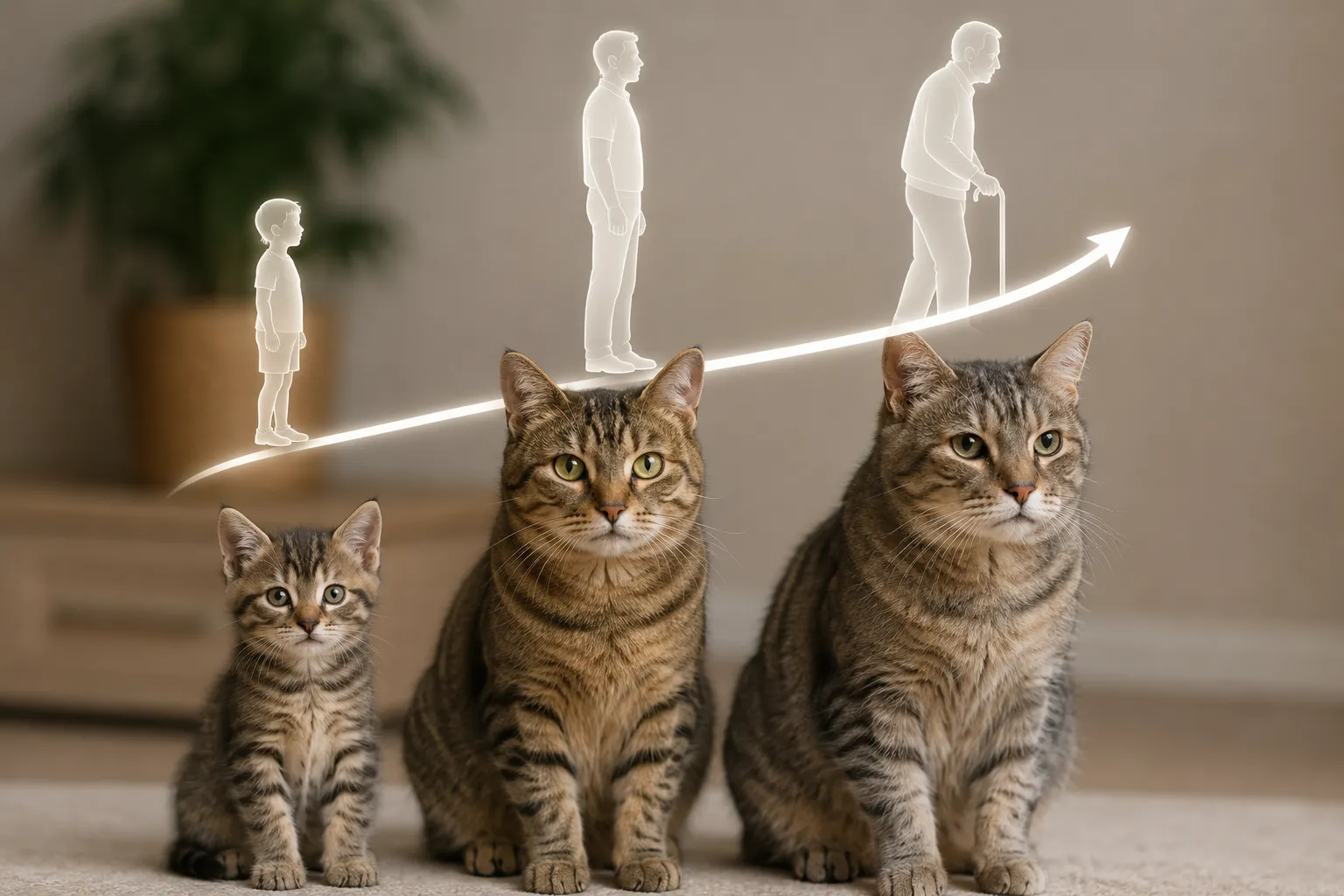
Use the Petopic cat age calculator to convert your cat’s age into an approximate human-age equivalent using their date of birth or their age in years and months. A one-year-old cat is roughly comparable to a 15-year-old human, while a two-year-old cat is around 24 in human years. After the second year, each additional cat year adds approximately four human years. Your result also shows your cat’s chronological age and current feline life stage.
The familiar idea that one cat year always equals seven human years is not accurate. Cats develop particularly quickly during kittenhood and their first two years of life. A one-year-old cat is already far more physically mature than a seven-year-old child, so multiplying every year by seven gives a misleading answer.
Quick answer: A one-year-old cat is approximately 15 in human years. A two-year-old cat is about 24. After that, add roughly four human years for every additional cat year.
Cat Age Calculator
Choose the date-of-birth option if you know when your cat was born. If you only know their approximate age, enter the number of completed years and additional months. The calculation takes place in your browser, and the information you enter is not submitted or stored.

How Do You Calculate Cat Years in Human Years?
A cat’s age is not converted by applying one fixed number throughout their life. The rapid development of the first two years and the steadier pace of adult ageing need to be considered separately.
- The first year: A one-year-old cat is approximately 15 in human years.
- The second year: The second year adds about nine more human years, bringing the total to roughly 24.
- After the second year: Each completed cat year adds approximately four human years.
Practical formula for cats older than two:
Human-age equivalent = 24 + (cat’s age − 2) × 4
For an eight-year-old cat, the calculation is 24 + (8 − 2) × 4. The approximate result is 48 human years.
This formula is a useful shortcut for cats over two years old. Months matter much more during kittenhood, so the calculator uses separate monthly reference points throughout the first two years.
How Does the Petopic Cat Age Calculator Work?
The calculator accepts age in two different ways:
- Enter the number of completed years and additional months.
- Select your cat’s date of birth.
When a date of birth is selected, the tool works out the completed calendar years and months between that date and today. It also accounts for the remaining part of the current month, so a cat aged 18 months and a cat approaching their second birthday do not receive exactly the same result.
The main reference points used during the first two years are:
- 1-month-old cat: approximately 1 human year
- 2-month-old cat: approximately 2 human years
- 3-month-old cat: approximately 4 human years
- 4-month-old cat: approximately 6 human years
- 5-month-old cat: approximately 8 human years
- 6-month-old cat: approximately 10 human years
- 7-month-old cat: approximately 12 human years
- 12-month-old cat: approximately 15 human years
- 18-month-old cat: approximately 21 human years
- 24-month-old cat: approximately 24 human years
For an age that falls between two reference points, the calculator moves gradually between the two values. After 24 months, it adds four human years for every additional 12 months.
Cat Age Chart: Cat Years to Human Years
The following cat years chart covers the most commonly searched kitten ages as well as cats from one to 25 years old. Every human-age equivalent is approximate.
| Cat’s chronological age | Approximate human age | Feline life stage |
|---|---|---|
| 0–1 month | 0–1 year | Kitten |
| 2 months | 2 years | Kitten |
| 3 months | 4 years | Kitten |
| 4 months | 6 years | Kitten |
| 5 months | 8 years | Kitten |
| 6 months | 10 years | Kitten |
| 7 months | 12 years | Junior |
| 1 year | 15 years | Junior |
| 18 months | 21 years | Junior |
| 2 years | 24 years | Junior |
| 3 years | 28 years | Adult |
| 4 years | 32 years | Adult |
| 5 years | 36 years | Adult |
| 6 years | 40 years | Adult |
| 7 years | 44 years | Mature |
| 8 years | 48 years | Mature |
| 9 years | 52 years | Mature |
| 10 years | 56 years | Mature |
| 11 years | 60 years | Senior |
| 12 years | 64 years | Senior |
| 13 years | 68 years | Senior |
| 14 years | 72 years | Senior |
| 15 years | 76 years | Super senior |
| 16 years | 80 years | Super senior |
| 17 years | 84 years | Super senior |
| 18 years | 88 years | Super senior |
| 19 years | 92 years | Super senior |
| 20 years | 96 years | Super senior |
| 21 years | 100 years | Super senior |
| 22 years | 104 years | Super senior |
| 23 years | 108 years | Super senior |
| 24 years | 112 years | Super senior |
| 25 years | 116 years | Super senior |
Life-stage note: Veterinary organisations sometimes group feline life stages differently. This guide uses the commonly recognised UK-friendly stages of kitten, junior, adult, mature, senior and super senior.
Why Is One Cat Year Not Equal to Seven Human Years?
The seven-year rule treats ageing as though it happens at the same pace throughout a cat’s life. It does not. A kitten develops from a newborn into an almost fully grown young cat within a remarkably short period.
Using the seven-year rule would make a one-year-old cat equivalent to a seven-year-old child. In reality, a one-year-old cat is much closer to the physical maturity associated with a human teenager. A two-year-old cat is not approximately 14 in human years; the more useful comparison is around 24.
The same problem appears in later life. Multiplying 15 by seven would produce 105, whereas the commonly used cat-age chart places a 15-year-old cat at approximately 76 human years.
No cat-to-human conversion is a precise biological measurement. Its purpose is to illustrate the speed at which cats move through different developmental and ageing stages.
How Do Kitten Months Convert into Human Years?
For a cat under one year old, describing them simply as “zero years old” is not very useful. A two-month-old kitten and an 11-month-old cat have very different nutritional, behavioural and developmental needs.
One- to two-month-old kittens
This is still a very early stage of development. A two-month-old kitten is approximately comparable to a two-year-old human in the age chart. That does not mean the kitten should be cared for like a human toddler; it only indicates that they remain at a very early developmental stage.
Three- to four-month-old kittens
A three-month-old kitten is approximately four in human years, while a four-month-old kitten is around six. Play, coordination, curiosity and social learning develop quickly during this period.
Five- to six-month-old kittens
A five-month-old kitten is roughly equivalent to eight human years, and a six-month-old kitten to about 10. Permanent teeth begin to replace baby teeth, and the kitten’s body shape can change noticeably.
Seven- to twelve-month-old cats
A seven-month-old cat is around 12 in human years. By the first birthday, the approximate comparison is 15. The cat may look nearly adult but can still be highly energetic, impulsive and playful.
For feeding, litter training, home safety and early health care, read the Petopic kitten care guide.
Feline Life Stages Explained
Finding out your cat’s age in human years is interesting, but their feline life stage is more useful when making everyday care decisions. Energy levels, feeding needs, dental care and health monitoring can change as a cat grows older.
| Life stage | Chronological age | Main considerations |
|---|---|---|
| Kitten | Birth to 6 months | Rapid growth, kitten food, early social learning and preventative health planning |
| Junior | 7 months to 2 years | Completing physical development, maintaining healthy habits, play and behaviour |
| Adult | 3 to 6 years | Weight management, dental health, activity and routine preventative care |
| Mature | 7 to 10 years | Monitoring weight, muscle condition, mobility and changes in daily habits |
| Senior | 11 to 14 years | Closer observation of appetite, drinking, toileting, movement and behaviour |
| Super senior | 15 years and older | Individualised support for comfort, mobility, nutrition and ongoing health conditions |
What Matters During the Kitten Stage?
Kittenhood involves extremely rapid physical growth and an equally important period of learning. The practical value of knowing a kitten’s age is understanding which developmental stage they have reached.
Important considerations include:
- Feeding a complete food designed for kittens
- Adjusting meal frequency and portion size as the kitten grows
- Planning vaccinations with a vet
- Assessing flea, worm and other parasite risks
- Monitoring steady weight gain
- Introducing a carrier and basic household routines positively
- Providing safe play and appropriate scratching opportunities
- Observing litter-tray habits
For a general overview of age-appropriate vaccinations, see the cat vaccination schedule. The exact programme must be based on the individual cat’s health, history and level of exposure.
What Does the Junior Life Stage Mean?
A junior cat is no longer a small kitten, but development is not necessarily complete. Between seven months and two years, cats often remain highly active and may continue refining their social and hunting-style play behaviours.
During this stage, focus on:
- Maintaining a healthy body condition
- Completing the transition from kitten to adult food at an appropriate time
- Providing daily physical and mental activity
- Watching for changes in litter-tray behaviour
- Introducing tooth care where possible
- Maintaining parasite prevention based on risk
- Discussing neutering, if it has not already been carried out
Adult Cats: Three to Six Years
Adult cats are commonly active, agile and settled into their normal personality. Looking healthy from the outside does not remove the need to monitor weight, dental health and gradual changes in behaviour.
Useful priorities include:
- Measuring food portions rather than estimating by eye
- Preventing slow, unnoticed weight gain
- Providing regular play and opportunities to climb or explore
- Monitoring the teeth and gums
- Noticing changes in thirst or toileting
- Keeping up with routine veterinary checks
- Reducing repeated sources of stress within the home
Food should be chosen according to age, weight, neutering status, lifestyle and health rather than marketing terms alone. The cat food selection guide explains the main factors to compare.
What Changes During the Mature Stage?
A seven-year-old cat is approximately 44 in human years, while a ten-year-old cat is around 56. Many cats remain lively throughout this stage, but small changes in weight, muscle condition, mobility and everyday routines can become more significant.
Do not automatically dismiss the following changes as normal ageing:
- Jumping less often than before
- Hesitating before climbing onto familiar furniture
- Unexplained weight gain or weight loss
- Drinking noticeably more water
- Changes in litter-tray use
- Bad breath or difficulty eating
- Reduced grooming
- Hiding more frequently
- New irritability or restlessness
A human-age conversion cannot diagnose illness. At the same time, assuming every change is simply caused by age may delay the investigation of pain or disease.
When Is a Cat Considered Senior?
In the life-stage system used on this page, cats aged 11 to 14 are senior. Cats aged 15 and over are described as super senior. An 11-year-old cat is approximately 60 in human years, while a 15-year-old cat is around 76.
It is helpful to monitor:
- Appetite and how long meals take to finish
- Noticeable increases or decreases in drinking
- Urination and bowel habits
- Weight and muscle loss
- Willingness to jump, climb stairs or use high resting places
- Coat condition and matting
- Changes in sleep patterns
- Calling at night or appearing disorientated
- Changes in social behaviour
- Overgrown or thickened claws
How Can You Tell a Cat’s Age If the Birth Date Is Unknown?
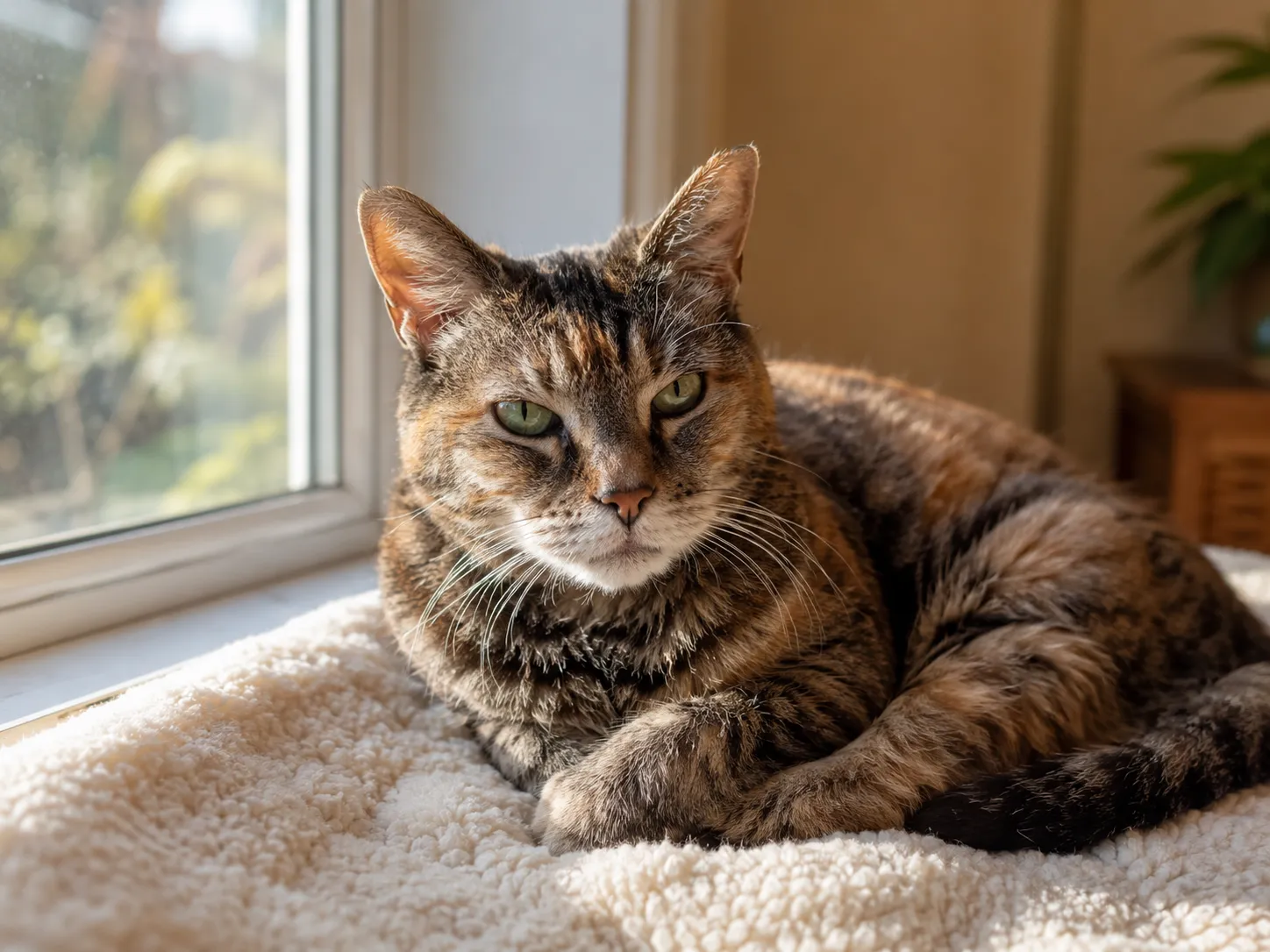
It is often impossible to identify the exact date of birth of a rescued, stray or previously rehomed adult cat from appearance alone. A vet can estimate an age range by considering the teeth, eyes, coat, claws, muscle condition, movement and overall health together.
An estimate is usually more precise in kittens because teeth and physical development change quickly over a short period. In an adult or older cat, a realistic assessment may be “approximately five to seven years old” rather than an exact age such as six years and three months.

How Can a Cat’s Teeth Help Estimate Age?
Dental development provides some of the most useful age clues during kittenhood. Kittens are born without visible teeth. Their baby teeth begin to emerge during the first weeks of life and are later replaced by permanent adult teeth.
A general timeline is:
- Early baby teeth may become visible from around the third week.
- Most baby teeth are present by approximately six to eight weeks.
- Permanent teeth may begin to emerge at around three to four months.
- Adult canine and back teeth continue appearing during the following months.
- By about six to seven months, most cats have their adult teeth.
In adult cats, tartar, staining, wear and missing teeth can provide clues, but they do not prove a particular age. An older cat with excellent dental care may have relatively clean teeth, while a much younger cat may have significant dental disease.
Can You Estimate a Cat’s Age from the Eyes?
The eyes may contribute to an overall estimate but cannot reveal a cat’s exact age. Younger cats often have clearer-looking eyes, while age-related changes can gradually affect the lens and iris.
Cloudiness, persistent discharge, redness, unequal pupils or apparent sight loss should not be assumed to be harmless effects of getting older. These may indicate an eye problem that needs assessment. For persistent discharge, see the guide to eye discharge in cats.
Can the Coat, Muscles and Claws Reveal Age?
Young adult cats commonly have stronger muscle definition, flexible movement and consistent grooming habits. Some older cats gradually lose muscle, groom less thoroughly or develop thicker claws.
However, none of these signs is exclusive to age:
- Poor nutrition can cause muscle loss in a young cat.
- Joint pain can make grooming difficult.
- Excess weight changes movement and body shape.
- Chronic illness can affect the coat and muscles.
- A young long-haired cat can become matted without regular grooming.
Coat condition, muscle mass and claws are most useful when considered alongside the teeth, eyes, behaviour and veterinary examination.
Can Behaviour Tell You How Old a Cat Is?
Behaviour may provide a broad impression, but it is not a reliable age test. Kittens often play in short, intense bursts and have less controlled movements. Junior and adult cats may remain highly active but become more coordinated and consistent.
Senior cats may sleep for longer or use high surfaces less frequently, but personality varies enormously. A calm young cat and an energetic older cat are both entirely possible. Pain, weight, stress and previous experiences can also alter behaviour.
Do Indoor and Outdoor Cats Use Different Age Calculations?
No. The human-age conversion is based on chronological age. A five-year-old indoor cat and a five-year-old outdoor cat both receive an approximate result of 36 human years.
Lifestyle can affect health, injury risk and physical condition, but it does not change the date on which a cat was born. Two cats of the same age may look or behave differently because of nutrition, stress, disease, parasites, trauma and access to veterinary care.
Does Breed Change a Cat’s Human-Age Equivalent?
The calculator uses the same conversion for all domestic cats. There is no widely accepted standard that assigns separate human-age multipliers to individual cat breeds.
Breed and genetics can affect susceptibility to certain conditions and may influence average lifespan, but they do not change chronological age. Two cats born on the same day receive the same age result even if they are different breeds.
Is the Calculation Different for Male and Female Cats?
No. Male and female cats use the same cat-years conversion. Sex can influence some health and behavioural considerations, but it does not create a separate human-age formula.
Does Neutering Change a Cat’s Human Age?
No. Neutered and unneutered cats use the same calculation. Neutering does not alter a cat’s date of birth or chronological age.
For information about timing, preparation, potential risks and recovery, read the cat neutering guide.
Why Is It Useful to Know Your Cat’s Age?
The human-age equivalent is mainly a helpful comparison. Knowing the cat’s chronological age and life stage has more practical value.
Age can help inform decisions about:
- Kitten, adult or senior food
- Portion size and weight monitoring
- Vaccination and parasite-risk discussions
- Dental care
- Play and environmental enrichment
- Neutering discussions
- Interpreting changes in behaviour
- The frequency and focus of veterinary checks
How Should Veterinary Checks Change with Age?
There is no single appointment schedule that suits every cat. Age needs to be considered alongside medical history, current medication, body condition, lifestyle and any existing symptoms.
- Kittens need repeated appointments for development and preventative care planning.
- Healthy junior and adult cats still benefit from routine health checks.
- Mature and senior cats may need closer monitoring of subtle changes.
- Cats with chronic disease require an individual follow-up plan.
If a newly adopted cat has no reliable age or health history, the first examination can include an estimated age range, dental assessment, weight check, vaccination discussion and parasite-risk review. The first vet visit guide can help you prepare.
Does the Human-Age Result Show a Cat’s Biological Health?
No. The calculator converts chronological age into an approximate developmental comparison. Two cats can receive the same human-age result while having very different levels of health and mobility.
Factors that can influence a cat’s physical condition include:
- Genetics
- Diet quality and portion control
- Being overweight or underweight
- Daily activity
- Dental health
- Previous illness or injury
- Parasite exposure
- Stress
- Living environment
- Access to veterinary care
A result of “56 human years” does not mean that a ten-year-old cat has the same diseases, physical abilities or life expectancy as a 56-year-old person.
Common Cat Age Calculation Mistakes
- Multiplying every year by seven: This ignores the rapid development of the first two years.
- Ignoring months in kittens: A few months can represent a major developmental difference.
- Treating the result as a medical measurement: The human-age result is only an approximate comparison.
- Using tartar to assign an exact age: Dental care and disease can substantially alter the appearance of teeth.
- Assuming a calm cat must be old: Personality and health influence behaviour.
- Assuming an active cat must be young: Many older cats remain playful and mobile.
- Dismissing weight loss as normal ageing: Unexplained physical changes need attention.
- Giving a rescued adult cat an exact birthday: A veterinary examination usually provides an estimated range.
Cat Ages in Human Years: Quick Answers
- 2-month-old cat: Approximately 2 human years
- 3-month-old cat: Approximately 4 human years
- 4-month-old cat: Approximately 6 human years
- 6-month-old cat: Approximately 10 human years
- 1-year-old cat: Approximately 15 human years
- 2-year-old cat: Approximately 24 human years
- 3-year-old cat: Approximately 28 human years
- 5-year-old cat: Approximately 36 human years
- 7-year-old cat: Approximately 44 human years
- 8-year-old cat: Approximately 48 human years
- 10-year-old cat: Approximately 56 human years
- 11-year-old cat: Approximately 60 human years
- 12-year-old cat: Approximately 64 human years
- 15-year-old cat: Approximately 76 human years
- 20-year-old cat: Approximately 96 human years
Conclusion: How Old Is Your Cat in Human Years?
Cat years do not convert into human years using one fixed multiplier. A one-year-old cat is approximately 15 in human years, while a two-year-old cat is around 24. Each completed year after that adds roughly four human years.
If the date of birth is known, the calculator uses the exact calendar age. When the date is unknown, enter the approximate years and months suggested by a vet. Teeth provide particularly useful clues in kittens, while adult cats need a broader assessment that considers the eyes, coat, muscles, claws, behaviour and medical history.
The human-age result satisfies curiosity, but the life stage provides more useful guidance. Use the result as a prompt to reconsider whether your cat’s food, weight monitoring, activity, dental care and veterinary support still suit their current stage of life.
Frequently Asked Questions
How old is a one-year-old cat in human years?
A one-year-old cat is approximately 15 in human years. Cats develop very quickly during their first year, so simply multiplying their age by seven does not give an accurate comparison.
How old is a two-year-old cat in human years?
A two-year-old cat is approximately 24 in human years. The first year accounts for about 15 human years and the second adds approximately nine more.
How old is a three-year-old cat in human years?
A three-year-old cat is approximately 28 in human years. After the second birthday, each additional cat year adds about four human years.
How old is a five-year-old cat in human years?
A five-year-old cat is approximately 36 in human years. This is calculated by adding 12 human years to the two-year-old equivalent of 24.
How old is a ten-year-old cat in human years?
A ten-year-old cat is approximately 56 in human years. In the life-stage system used on this page, a ten-year-old cat is in the mature stage and becomes senior at 11.
How old is a 15-year-old cat in human years?
A 15-year-old cat is approximately 76 in human years. This is considered the beginning of the super-senior feline life stage.
How old is a six-month-old kitten in human years?
A six-month-old kitten is approximately comparable to a ten-year-old human in the age chart. This is only a developmental comparison and does not mean the kitten has the same care needs as a human child.
How old is a two-month-old kitten in human years?
A two-month-old kitten is approximately comparable to a two-year-old human. At this stage, correct nutrition, development and preventative health care matter more than the human-age comparison itself.
Is one cat year really equal to seven human years?
No. Cats develop much faster during their first two years. A one-year-old cat is approximately 15 in human years and a two-year-old cat is around 24. Each later cat year adds about four human years.
How can you tell a cat’s age if you do not know the birth date?
A vet can estimate an age range by examining the teeth, eyes, coat, claws, muscles, movement and general health. Kittens can often be estimated more closely than adult cats because their teeth and physical development change rapidly.
Can a cat’s teeth reveal their exact age?
Teeth provide strong clues during kittenhood, but they rarely reveal an adult cat’s exact age. Dental care, diet, disease and previous injuries can all change the appearance of the teeth.
Do indoor and outdoor cats use different age calculations?
No. The conversion is based on chronological age. Lifestyle can affect health and physical condition, but a five-year-old indoor cat and a five-year-old outdoor cat receive the same approximate human-age result.
Does cat breed change the human-age calculation?
The standard cat-age conversion does not use separate multipliers for different breeds. Breed and genetics may affect health risks or average lifespan, but they do not change a cat’s chronological age.
Is the calculation different for neutered cats?
No. Neutered and unneutered cats use the same age conversion. Neutering does not alter a cat’s date of birth, chronological age or human-age equivalent.
At what age is a cat considered senior?
In the life-stage system used here, cats are considered senior from 11 to 14 years old. Cats aged 15 and over are described as super senior.
Can the cat age calculator predict how long my cat will live?
No. The calculator only compares chronological age with an approximate human-age equivalent. Lifespan depends on genetics, health, nutrition, body condition, lifestyle and veterinary care.